



Industrial safety in the United States as we know it today did not begin to take shape until the early 20th century. Before that, many risked their lives daily going to work in industrial settings that included mines, construction, mills and manufacturing. In today's world, work safety statistics are usually measured by the number of injuries or deaths that take place yearly. Prior to 1900 these type of statistics are hard to come by, in part because it appeared that no one cared enough to make tracking on-the-job injuries and deaths a priority.
19th Century Bleakness
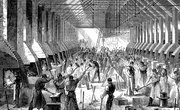
There is little doubt that workers faced new and unprecedented dangers when the industrial revolution arrived on U.S. shores. American entrepreneurs developed labor-saving devices and machinery that, albeit profitable and highly productive, were often very dangerous. Workplace accidents did not impact the bottom line, since the only legal recourse for victims was suing the company. Those that went to court rarely won their case, and thus made work safety an unprofitable venture for many industrialists of the time
Mining, train transportation and manufacturing were probably the most hazardous occupations of the time, and workers responded by taking out insurance policies to cover themselves in the case of a death or an accident, or by leaving a job altogether. This resulted in companies paying higher wages for jobs that were deemed more dangerous.
Public Efforts Lead to Improvements
Federal safety regulation traces its birth to the creation of the Food and Drug Administration (FDA), and the Bureau of Mines, both which occurred prior to the United States' entry into World War I. Thanks in part to news coverage, the efforts of labor unions and some more progressive business men, the issue of work safety came to the forefront.
Unions representing trainmen campaigned for equipment improvements to ensure train and freight cart safety, and in 1910 the Bureau of Mines was established to identify new ways to make mines safer after a series of dangerous mine explosions.
Workman's Compensation is Born
Congress passed a federal employers' liability law in 1908 that made it more expensive for companies to have an accident on their books. The law applied to railroad workers in interstate commerce, and made it harder for companies to claim that the employee was partially responsible for an injury. Thanks to the new law, worker injuries that once cost companies $200 to resolve now cost almost $2,000.
In 1910, the state of New York created a workmen's compensation law that forced companies to automatically compensate for workplace injuries (eliminating the need for families to take corporations to court). By 1921, 43 more states had followed New York's lead and established their own compensation laws.
Employers Take Action
Compensation laws and other liability costs suddenly made workplace injuries an expensive proposition for many employers. What followed was a slow but steady increase in workplace safety. Large firms in railroading, mining and manufacturing suddenly became interested in safety. Manufacturing companies began to work to create safer equipment, and managers in many industries began getting tasked with identifying workplace dangers. In mining and construction, for instance, workers began to wear safety glasses and hard hats.
In 1913 the National Safety Council was formed by a group of business owners to pool shared knowledge, and to apply the information gathered through national agencies like the Bureau of Mines.
Between World Wars I and II accidents in the workplace declined at an uneven rate, and it should be noted that during times of economic boom safety law enforcement tended to take a back seat.
Post World War II to the Present
The Occupational Safety and Health Administration (OSHA) and the Mine Safety and Health Administration were established in 1970. In addition worker's unions became more powerful than ever after World War II, and made work safety a priority.
Safety in the workplace remains a top concern for most U.S. industries---which must follow OSHA rules as well as rules and regulations established by other safety councils within specific industries. Workplace injury has steadily declined since World War I, and today meticulous records are kept of every injury, illness or fatality that occurs in a workplace.
Related Articles


References
Writer Bio
Based in Charlotte, N.C., Virginia Franco has more than 15 years experience freelance writing. Her work has appeared in various print and online publications, including the education magazine "My School Rocks" and Work.com. Franco has a master's degree in social work with an emphasis in health care from the University of Maryland and a journalism degree from the University of Richmond.