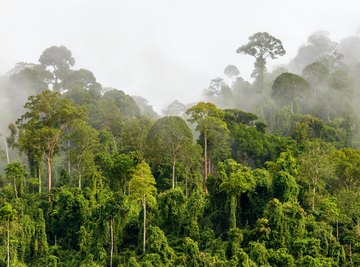

Rainforests are impressively wet and humid ecosystems found from the tropics to the boreal zone, though they tend to be much more extensive in the equatorial latitudes. Although temperature and evaporation rates play significant roles in establishing the conditions for rainforest climate, average annual precipitation – and, specifically, quite a lot of it – is the defining environmental factor: certain rainforest zones rank among the very wettest places on Earth.
TL;DR (Too Long; Didn't Read)
Rainforests typically receive copious amounts of rain each year. But not all rainforests are alike. The type of rainforest and its location determines annual rainfall amounts:
- Equatorial rainforests receive more than 80 inches of rain annually.
- Montane rainforests and cloud forests obtain up to 79 inches of rain per year.
- Monsoon rainforests get from between 100 to 200 inches of rain annually.
- Temperate and boreal rainforests receive over 55 inches of rainfall per year, but some locations have received from 33 to 320 inches per year.
Equatorial Rainforest
The bulk of tropical evergreen rainforest lies in that equatorial climate zone defined in the widely used Köppen scheme as tropical wet, characterized by warm year-round temperatures with very little annual variation. These equatorial rainforests – the largest within he Amazon Basin of South America and the second-largest in central Africa’s Congo Basin – typically receive more than 80 inches of rain per year, and this precipitation falls evenly across the calendar. A remarkable diversity of trees composes the multilayered canopies of equatorial rainforests, and – without any major dry season to contend with – these trees are evergreen: that is, they sport leaves throughout the year.
Montane Rainforest and Cloud Forest
Above the lowland rainforest on tropical mountainsides, and on the windward slopes of subtropical mountains, cooler, higher-elevation forms of rainforest – generally termed tropical montane rainforest – may develop. A sub-type called a cloud forest often forms the uppermost reach of rainforest at elevations between 1,300 and 9,200 feet or more depending on the setting; these ecosystems, commonly characterized by stunted trees cloaked in moss, ferns and other epiphytes (arboreal plants and lichens), typically receive on the order of 79 inches of rainfall.
Precipitation generated by air rising up mountain slopes – the orographic effect – helps fuel the cloud forest’s luxuriant vegetation, but so does the persistent fog and mist resulting from high humidity: condensation from these cloud layers onto leaves and epiphyte-furred branches and trunks adds a significant amount of available moisture to the forest via fog drip.
Monsoon Forest
The equatorial rainforests of the tropical-wet climate zone aren’t the very wettest forests in the tropics: they’re rivaled or even surpassed by the monsoon forests of the tropical-monsoonal zone, which typically receives 100 to 200 inches of rain per year. Unlike equatorial rainforests, monsoon forests experience a dry season part of the year, dominated by offshore winds, contrasting with a wet season of moist onshore winds and often-torrential rains. The Khasi Hills of Northeast India garner epic downpours during the summer monsoon. One site, Cherapunji, holds the record for the greatest one-year precipitation total anywhere: a whopping 87 feet from August 1860 to July 1861. In the month of July alone, 366 inches of rain fell.
Temperate and Boreal Rainforests
While the steaming tropical canopies of the neotropics, Central Africa and Southeast Asia may be the quintessential image of rainforest in many people’s minds, counterparts exist far outside the equatorial belt. Temperate rainforests flourish most extensively in West Coast marine climates, which enjoy moderate temperatures and plentiful precipitation. The largest expanse – home to some of the tallest and biggest trees in the world, from redwood and Douglas fir to Sitka spruce – stretches from northern California to southeastern Alaska on the Pacific Coast of North America, grading into boreal rainforest at its northernmost. Other significant temperate rainforests lie in Chile and New Zealand, though – historically, anyway – the British Isles, Scandinavia, Japan and other far-flung spots host smaller tracts.
Temperate rainforests, when compared with tropical rainforests, require less precipitation to maintain high levels of humidity because of their colder temperatures. One widely used definition suggests temperate rainforest receives more than 55 inches of annual precipitation, while the exhaustive book, “Temperate and Boreal Rainforests of the World” defined a broad range of precipitation -- including the boreal variety -- of between 33 and 320 inches, with as much as 25 percent falling during the given location’s driest season.
References
- Mongabay: Types of Rainforests
- NASA Earth Observatory: Rainforest
- Mongabay: Rainforest Ecology
- Temperate & Boreal Rainforests of the World; Dominick A. DellaSala (ed.)
- Mongabay: Rainforests
- Vegetation of the Earth; Heinrich Walter
- Revista Chilena de Historia Natural: Comparative Ecology of Temperate Rainforests of the Americas Along Analogous Climatic Gradients; Paul B. Alaback
- Physical Geography: A Landscape Appreciation; Tom L. McKnight
About the Author
Ethan Shaw is an independent naturalist and freelance outdoors/nature writer based in Oregon. He holds a B.S. in Wildlife Ecology and a graduate certificate in G.I.S. from the University of Wisconsin-Madison. His primary interests from both a fieldwork and writing perspective include landscape ecology, geomorphology, the classification of ecosystems, biogeography, wildlife/habitat relationships, and historical ecology. He’s written for a variety of outlets, including Earth Touch News, RootsRated, Backpacker, Terrain.org, and Atlas Obscura, and is presently working on a field guide.