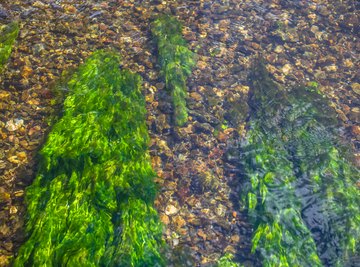
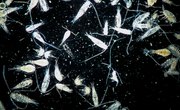
The world's oceans are filled with microscopic plants called phytoplankton. Sometimes called the "plants of the sea," phytoplankton form the bottom of the aquatic food chain, serving as nutrition for a wide range of organisms, including fish that humans catch and eat. Phytoplankton, however, make their own food through the process of photosynthesis.
Plankton Definition
Plankton means "to wander or drift." Phyto comes from the Greek word for plant. Phytoplankton therefore are drifting plants found in aquatic environments like oceans, rivers and lakes. Phytoplankton range from photosynthetic bacteria to diatoms and dinoflagellates.
Photosynthesis
Phytoplankton contain chlorophyll which allows them to convert sunlight into energy. In the process known as photosynthesis, phytoplankton use energy from sunlight to combine water and carbon dioxide to form glucose, a form of sugar, which they store as carbohydrates to use as nutrients.
Like plants on land, phytoplankton convert the sugar to energy in the process called cellular respiration. The sugar is converted into adenosine triphosphate (ATP), the form of energy organisms can use. So, it could be said that photosynthetic plankton eat sunshine.
Nutrients
Along with sunlight, water and carbon dioxide, phytoplankton require a variety of other nutrients from the water including nitrogen, phosphorous and iron. The most important are nitrogen and phosphorous which are essential to survival and reproduction. Nitrogen is in short supply in some areas but in other areas, phosphorous is limited. Phytoplankton cannot continue to grow when one or the other has been used up.
Nutrient Sources
The nutrients phytoplankton require are created in nature when rocks weather and from atmospheric conditions that convert nitrogen gas into a usable form. In addition, humans introduce phosphorous and nitrogen to the water as runoff from such things as detergents, sewage and fertilizers.
Environmental Importance
The fact that phytoplankton are common, live in all the Earth's oceans and rely on basic environmental conditions found in seawater and sunlight makes them a good source of study on changes in the environment and climate. Scientists can study their abundance or chemistry, viewing them as early warning signals of changes in the earth's climate, seawater or other environmental conditions.
Carbon Influence
Although minuscule in size, phytoplankton have a large effect on our world. Their abundance in the oceans, with their process of photosynthesis and use of carbon dioxide, helps ensure a balance in the carbon that is transferred along the food chain. The more phytoplankton pulls carbon dioxide from the environment, the lower the amount of this gas. Some theorize that by using carbon dioxide in the nutritional process, phytoplankton populations help decrease carbon dioxide levels that contribute to global warming.
Considerations
Phytoplankton are on the bottom of the aquatic food chain, so their nourishment and population growth are essential to other creatures from the small fish that eat them, to larger fish and eventually, humans. If phytoplankton cannot survive, they cannot support the other organisms that eat the phytoplankton and those organisms also die.
From tiny zooplankton to filter-feeders like giant larvacean and barnacles to whales, most of the marine food chain depends on phytoplankton. A notable exception lies along deep ocean vents where chemosynthetic bacteria form the base of the food chain.
Studies
In 2008 the Massachusetts Institute of Technology, supported by the National Science Foundation, created a detailed study of the food-finding ability of phytoplankton. The study's design considered the "foraging abilities and behavior of marine microbes" based on the belief that the environmental factors influencing phytoplankton was essential in understanding environmental fluctuations.
References
- Massachusetts Institute of Technology: A Plankton-Eat-Plankton World
- National Oceanic and Atmospheric Administration: Aquatic Food Webs
- U.S. Global Change Research Program: Ocean Chlorophyll Concentrations
- University of Miami Shark Research & Conservation Program: Phytoplankton: Small Organisms with a Massive Impact
About the Author
Rosanne Knorr is an award-winning writer, editor and author since 1980. She has written feature articles for countless publications and has authored 13 books including "The Grown-Up's Guide to Running Away from Home." She ghostwrites books on financial and lifestyle topics. She has taught creative writing and speaks on writing and travel topics. Knorr holds a Bachelor of Arts in English.