What Does a Transistor Do?

What Does a Transistor Do? thumbnail
What Does a Transistor Do?

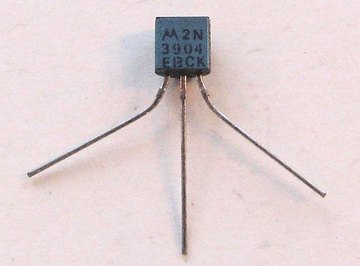
A transistor is a solid state device used to amplify a signal or serve as a switch. Transistors are referred to as solid state because they do not contain electro-mechanical components and, thus, are solid and do not move. Transistors were developed as the natural progression from vacuum tube electronics, and were a response to cost, manufacturing complexity, and reliability issues with vacuum tubes. The development of the transistor was one of the primary drivers behind the development of modern micro and digital electronics.

  1. History

    • The first recognized patent on a field effect solid state transistor was issued in 1947 to Bell Laboratories. The transistor was patented after two scientists at Bell, John Bardeen and Walter Brattain, noticed that germanium acted as a natural amplifier. They made a simple audio amplifier, and demonstrated it to the director of Bell, who immediately recognized the discovery's potential: low power consumption and no warm-up time. This first transistor was a bipolar junction transistor (BJT). BJT transistors contain two poles, or diodes, with a shared anode.

    Transistors as Amplifiers

    • The first transistors, developed by Bell Labs, were amplifiers. When power is applied to the transistor, a signal's input voltage was increased, creating a more powerful output. The input signal is applied to one pole of the transistor, when power is applied to the anode, the anode pulls electrons to the other pole at a higher rate than the input. The net effect is an amplification of the voltage output by the second pole.

    Transistors as Switches

    • Transistorized switches have evolved as the basis of digital electronics. In a transistor, a current is applied to a pole of the transistor. In many switching transistors, the current will not flow across the anode to the opposite pole, unless power is applied to the anode. This effectively turns the transistor in to an electronic on-off switch. When power is applied to the anode, power or signal flows out of the transistor. When power is not applied, the transistor is effectively in the "Off" position.

    How a Transistor is Made

    • Transistors have now been miniaturized to the point that millions can be etched onto the surface of a single silicon based microchip. Early transistors were made by sandwiching semiconductor materials. When current is applied to the material in between the two diodes, it allows current to flow between the diodes, thus acting as a switch. If the transistor is a current amplifier, the material between the two diodes increases the power output by the transistor, creating amplification. Early transistors were made by growing semiconductor crystals with the diode junctions in place. There are numerous modern methods of manufacturing transistors, with the most common being etching transistor components on silicon.

    Modern Transistor Miniaturization

    • Modern transistors have been miniaturized to incredibly small levels. Intel's proposed Itanium processor will contain over 2 billion transistors on a single integrated circuit. British scientists have made the smallest practical transistor measuring one atom thick by 10 atoms across. This experimental transistor is 1/3 of the size of the current smallest transistor possible on silicon integrated circuits.

Related Searches:
  • Photo Credit Photo: stock.xchng

Comments

You May Also Like

  • What Is a Bipolar Transistor?

    In modern electronic systems, the bipolar transistor quickly replaced the vacuum tube in all but high power applications. Miniaturized and mass produced,...

  • How Do Transistors Work As Inverters?

    Transistors are key components of power inverters, which convert direct current (DC) to alternating current (AC) power. The transistor is used to...

  • What Is the Purpose of a Transistor?

    Electronic engineers use transistors to control the flow of electricity in circuits. They can operate up to billions of cycles per second,...

  • How Do Transistors Fail?

    There's no reason why a solid-state component like a transistor must fail. Semiconductor devices could theoretically last forever if they're designed, constructed...

  • What Does the Spleen Do?

    The spleen is a part of the body's lymphatic system, located just under the rib cage on the left side of the...

  • How Do Transistors Work?

    Transistors are based mostly on silicon cut into slices and made into semi-conductors which are then exposed to special chemicals. Discover how...

  • What Does a Noise Gate Do?

    Noise gates are now in common use by any professional live or studio recording engineer. They are essential in making sure that...

  • What Are Transistors Used For?

    What Are Transistors Used For?. The transistor is perhaps the most ubiquitous component in electronic devices. Owing to their small size, high...

  • What Does a Nand Gate Look Like?

    A NAND gate is an electrical logic component made of a configuration of transistors. A transistor is a device that amplifies a...

  • What Does Vitamin D Do in the Body?

    Vitamin D, also called calciferol, is a fat-soluble vitamin which means it is found primarily in animal fat. Unlike other vitamins that...

  • What Is a Transistor Radio?

    The iPod of its time, the transistor radio sparked a pocket-sized revolution in the 1950s. A technological innovation allowed manufacturers to create...

  • What Is a Spin Transistor?

    Modern electronics rely heavily on transistors -- switches that control the flow of electrical current. The spin transistor is a device designed...

  • What Do Fleas Look Like?

    Fleas are 1 to 10 millimeters long, are flattened side-to-side and have enlarged hind legs. Discover how to identify fleas by their...

  • What Is a Field Effect Transistor?

    This article will discuss one of the two main types of semiconductor transistor, the field effect Transistor or FET. The other type...

  • What Does Power of Attorney Do?

    Power of attorney gives one person, called an agent, the authority to transact certain legal business on behalf of the authorizing person,...

  • The History of Transistors

    The transistor is considered by many historians to be the greatest invention of the 20th century. Not only did it miniaturize many...

  • What Do Optocouplers Do?

    An optocoupler---also referred to as an opto-isolator, photocoupler or photoMOS---is a piece of an electric circuit that transfers electricity between two other...

  • Radiation Transistor Effects

    The Radiation Science and Engineering Center (RSEC) at Penn State University promotes research and provides comprehensive information about safe use of nuclear...

  • How to Test PNP Transistors

    Electronic systems with transistors can be tested with an ohmmeter. You can remove transistors from their sockets and perform some simple tests....

  • How to Use a Pnp Transistor As a Switch

    A PNP transistor, an electronic component with three leads used to amplify electrical current and voltage, can and is often used to...

Related Ads

Featured