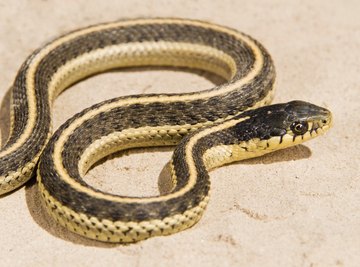
Most of the 37 species of snakes found in North Carolina are not venomous -- only six of them fit that description. Five of the venomous species are pit vipers, belonging to the Viperidae family and are responsible for most of the reported venomous snake bites in North Carolina, while the sixth species belongs to the Elapidae family and is related to the cobras of India.
All of the non-venomous snakes in North Carolina belong to the Colubridae family and vary in size, color pattern and preferred habitat.
Venomous Snakes
Most venomous snakes in North Carolina will slither away if they encounter humans. They only strike and release their venom when they feel attacked or when they hunt.
The rare eastern coral snake (Micrurus fulvius) is especially shy, making it one of the harder snake identifier species. It has yellow, red and black banding and is relatively small at up to 3 feet long. The eastern coral snake is extremely poisonous and usually hunts at night.
The pit viper snakes of North Carolina are the copperhead (Agkistrodon contortrix), cottonmouth (Agkistrodon piscivorous), eastern diamondback rattlesnake (Crotalus adamanteus), timber rattlesnake (Crotalus horridus) and pygmy rattlesnake (Sistrurus millarius).
Pit vipers are sone easy snake identifier species: you can identify pit vipers by their diamond- or triangular-shaped head, cat-like pupils, facial pits beneath their eyes and their two long fangs.
The facial pits serve as heat detectors, helping the snakes to find their warm-blooded prey. Rattlesnakes also possess night vision and so can hunt day or night.
Non-Venomous Snakes in North Carolina
Unlike venomous snakes, almost all non-venomous snakes have a tapered, smooth head, round pupils and small teeth instead of fangs. The bite from a non-venomous snake looks like scratches arranged in a horseshoe pattern, whereas a bite from a venomous snake leaves one or two puncture wounds. Non-venomous snakes encompass a large variety of snakes from a few inches to 8 feet in length.
To identify these snakes, look at some snake images and note their body thickness, scale color and pattern and their habitat location. The rat snake (Elaphe obsolete), eastern kingsnake (Lampropeltis getula) and rough green snake (Opheodrys aestivus) are found throughout most of North Carolina, while the coachwhip (Masticophis flagellum) inhabits only the Sandhills and southeastern Coastal Plain.
Rat snakes are large snakes with variable color patterns from all black to stripes with a yellow-green pattern, depending on location.
The up to 7-feet-long eastern kingsnake is black or brown and has a chain-like pattern that is sometimes broken up into spots. Rough green snakes are slim and like to climb; they are gentle when captured.
Coachwhips are slender, and at 4 to 8 feet are the longest snakes in North Carolina. They are black in front and faded black or grey near their end, with a tail that resembles a braided whip. These snakes are very quick and sometimes climb trees.
Aquatic Snakes
Some of North Carolina's snakes prefer aquatic environments. The large, stout northern water snake (Nerodia sipedon) can be found throughout central regions, the Northern Coastal Plain and aqueous sites in the mountains of North Carolina. In contrast, the banded water snake (Nerodia fasciata), brown water snake (Nerodia taxispilota), redbelly water snake (Nerodia erythrogaster) and the venomous cottonmouth are usually only found in the swamps, rivers, lakes and canals of the Coastal Plain region.
The northern water snake varies in color from reddish brown to dark gray and black with distinct lighter crossbands, which fade as the snake ages. The banded and brown water snakes are large brownish snakes marked with dark bands or blotches that you can see clearly in snake images and pictures.
The redbelly water snake is not banded and has a dark back and an orangey-red belly. Unlike other water snakes, the redbelly water snake sometimes travels a great distance from its aquatic habitat.
Cottonmouths, sometimes called water moccasins, are brown or olive snakes with dark body bands. The cottonmouth is distinguished by the white coloration inside its mouth; its venom is extremely toxic.
Common Snakes
Several of North Carolina's non-venomous and one of its venomous snakes, the copperhead, are quite common. The non-venomous rat snake hunts rats, mice and reptiles. The eastern king snake feeds on other snakes, including copperheads. Both the rat snake and the eastern king snake may hang out around buildings.
The slender rough green snake and coachwhip are predominately found in forested areas. The rough green snake eats insects, while the coachwhip feeds on mice, eggs and small reptiles. The shy brown water snake often suns itself on branches overhanging waterways and drops into the water when disturbed. The common brown water snake will seek out weak or injured fish to eat.
The venomous copperhead feeds on insects, mice and reptiles. It lives in woody areas, often near aquatic sites because of the abundance of prey. Copperheads may hide under large stones, wood or compost piles.
Endangered Species
Two venomous snakes, the eastern coral snake and the eastern diamondback rattlesnake, are federally listed as endangered species. Another group, mostly non-venomous, are on a list of concern.
The eastern coral snake produces a lethal neurotoxic venom and can be distinguished from non-venomous mimics, such as the scarlet kingsnake, by its adjoining yellow and red banding. The eastern diamondback rattlesnake, native to North Carolina, is the longest known rattlesnake at up to 8 feet long. Due to habitat destruction and killing of adult snakes, it became a threatened species and now is protected in North Carolina.
Another venomous snake, the timber rattlesnake, is on the Species of Concern list of the North Carolina Wildlife Resource Commission. The timber rattlesnake has been displaced from the central region of North Carolina by agriculture and development and now is only found in coastal regions and the mountains.
Non-venomous snakes that may be threatened with extinction and are of special concern are the northern pine snake (Pituophis melanoleucus), southern hognose snake (Heterodon simus) and specific snakes such as the Carolina water snake (Nerodia sipedon williamengelsi) and the outer banks kingsnake (Lampropeltis getula sticticeps).
References
- North Carolina State University Cooperative Extension: North Carolina Venomous Snakes
- Carolinas Poison Center: Snakes
- North Carolina Wildlife Resource Commission: Protected Wildlife Species of North Carolina
- Davidson College: Snakes of North Carolina
- North Carolina State University Cooperative Extension: North Carolina Snake Pictures
About the Author
Based in Connecticut, Marie-Luise Blue writes a local gardening column and has been published in "Organic Gardening" and "Back Home." Blue has a Ph.D. in biological sciences from the State University of New York at Stony Brook and wrote scientific articles for almost 20 years before starting to write gardening articles in 2004.
Photo Credits
VibeImages/iStock/Getty Images