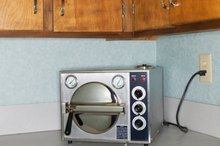
An autoclave is a device that is used to sterilize medical, beautician and other equipment such as tattooing and piercing paraphernalia. The basic function of the machine is to kill bacteria. This is done through application of extreme heat, steam and pressure to the articles placed in the sterilization chamber. This is accomplished by the removal of air from the sterilization chamber to create a vacuum, then superheated steam is applied. There are several types of autoclave in use 1.
Downward Displacement
The downward displacement autoclave is also referred to as a gravity displacement unit. This is because of the method of air removal in the sterilization chamber. A heating element is submerged in a pool of water, which, when heated, becomes steam. As steam is lighter than air, it forces the air in the sterilization chamber downward and out through a drain hole. Once the temperature in the sterilization chamber is sufficient, the drain hole is closed automatically and the sterilization process begins.
- The downward displacement autoclave is also referred to as a gravity displacement unit.
- As steam is lighter than air, it forces the air in the sterilization chamber downward and out through a drain hole.
Positive Pressure Displacement
Equipment for Checking Blood Pressure
Learn More
A positive pressure displacement autoclave is an improvement upon the design of a downward displacement unit. Steam is created in a second, separate chamber and held until the proper amount to displace all of the air in the sterilization chamber is accumulated. The steam is then released into the sterilization chamber in a pressurized blast, forcing the air out through the drain hole and starting the sterilization process. This has the effect of a more accurate displacement of air than a downward displacement unit can achieve.
- A positive pressure displacement autoclave is an improvement upon the design of a downward displacement unit.
- Steam is created in a second, separate chamber and held until the proper amount to displace all of the air in the sterilization chamber is accumulated.
Negative Pressure Displacement
A negative pressure displacement autoclave is one of the most accurate types of unit available 1. Once the sterilization chamber door is closed, a vacuum pump removes the air. Steam is created in a second, separate chamber. Once the air has been completely removed from the sterilization chamber, the steam is then released into the sterilization chamber in a pressurized blast much like that of a positive pressure displacement unit. The negative pressure displacement unit is able to achieve a high "Sterility Assurance Level" (SAL), but the system can be quite large and costly.
Triple Vacuum Autoclave
How to Assemble a Blood Pressure Cuff
Learn More
A triple vacuum autoclave is set up in a similar fashion to a negative pressure displacement unit in that there is a vacuum pump to remove air from the sterilization chamber and steam is created in a second, separate chamber or unit. The process begins by the vacuum removing the air, then a pulse of steam. This is repeated three times, hence the name "triple vacuum" autoclave. This type of autoclave is suitable for all types of instruments and is very versatile.
- A triple vacuum autoclave is set up in a similar fashion to a negative pressure displacement unit in that there is a vacuum pump to remove air from the sterilization chamber and steam is created in a second, separate chamber or unit.
Type "N" vs. Type "B"
Each autoclave can be classified as a type "N" unit or a type "B" unit 1. Type "N" units do not use a vacuum to remove air from the sterilization chamber, whereas type "B" units do use a vacuum pump. The difference in operation means type "N" autoclaves are suitable for a specific type of load--for solid, unwrapped instruments. Type "B" autoclaves can be used on wrapped and hollow instruments, which means a piece of equipment can be sterilized now for use later.
- Each autoclave can be classified as a type "N" unit or a type "B" unit 1.
- Type "B" autoclaves can be used on wrapped and hollow instruments, which means a piece of equipment can be sterilized now for use later.
Related Articles
Equipment for Checking Blood Pressure
Learn More
How to Assemble a Blood Pressure Cuff
Learn More

How to Measure Heart Rate on a Telemetry Strip
Learn More

How to Tell if a Thermometer Is Mercury
Learn More

How Do Automatic Blood Pressure Monitors Work?
Learn More

How to Troubleshoot a CPAP RemStar Auto M Series
Learn More
Parts & Functions of an Autoclave
Learn More
How to Adjust the Airflow on a ResMed CPAP S6
Learn More
How to Set the Pressure on a BiPAP Machine
Learn More

Naughton Treadmill Protocol
Learn More
References
Writer Bio
Gwen Wark is a freelance writer working from London, Dublin, and New York. She has been a published writer since 1998 with works appearing in both university and local publications. Her current writing projects include SEO, web copy, print and advertising features. She holds a Bachelor of Arts in English with a minor in history from Rutgers University.