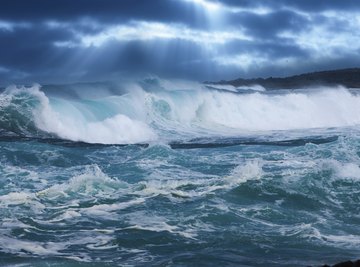

What's the difference between a swell and a wave? A sea swell, meaning a collection of waves produced by storm winds raging hundreds of miles out to sea, is different from waves, which are the product of local winds along coastal beaches. They are formed by a combination of factors that occur on the earth's surface and in our solar system, notes Smithsonian. Swells are coveted by surfers looking to catch a big wave, like those found at Waimea Bay on the shore of O‘ahu, Hawai‘i. According to the University of Hawai‘i, ocean swells at Waimea Bay can reach over ten meters. However, ocean swells this big are not so revered by boaters, as large swells can capsize ships.
How Swells Form
A swell in the ocean is formed through a combination of wind strength, wind duration and fetch. Wind strength is how fast the wind blows across the surface of the ocean. Wind duration is how long it blows without interruption. Fetch is the distance wind blows across the surface without disruption from obstacles.
As wind blows across the water’s surface, friction occurs and energy is transferred from wind to water. The result is a rising crest that forms into a wave. Over time and distance, sustained wind strength and duration build up a large amount of energy beneath the ocean’s surface, forming deeper waves known as swells. This energy fuels a swell so it can travel thousands of miles without changes in height or shape.
Height of Swells
As swells move away from the storm area where they formed, they become rounded and begin to flatten. The height of each wave in a swell varies. Height is measured from the lowest point to the highest point of the wave; in other words, it is the difference between the crest of one swell to the trough of the next swell, according to the National Oceanic and Atmospheric Administration.
Since waves vary in size, surf forecasters usually give the swell height as the average height of the tallest one-third of waves in a collection. As a rule of thumb, the larger the height of a swell, the bigger the waves it will produce when it approaches the coast.
Measuring Swell Periods
Wave terms include swell period, which is the number of seconds between successive swell crests as they pass the same stationary object, such as a piling or buoy. The greater the number of seconds between swells, the larger the resulting wave. Ideal waves for surfing have a swell period of 12 seconds or longer, so swell periods of less than 11 seconds are usually not included in the average.
Longer swell periods indicate a swell with deep-penetrating energy that will be forced to the surface when the swell approaches the coast, producing a wave up to one and a half times taller than the swell was over open water. This forcing up of energy by the ocean floor to create a much larger wave is referred to as groundswell.
Direction of Swells
Swell direction is the direction the swell is coming from, as opposed to the direction it is heading toward. A collection of ocean swells moves in a general direction, but does not move in the exact same heading.
Swells are redirected by shallow spots on the ocean floor. Shallow areas slow down the speed of the swell, while the portion of it passing over deep water maintains its speed. This slowing down, which "bends" the wave, is called refraction. Knowing swell direction helps boaters navigate the swell and surfers determine where to position themselves to ride a wave.
References
Resources
About the Author
Diana K. Williams is a certified Master Gardener, has more than a decade of experience as an environmental scientist, and holds a Bachelor of Science degree in biology and environmental studies from the Ohio Northern University. Williams is a winner of Writer’s Digest Magazine's annual writing competition.
Photo Credits
irabell/iStock/Getty Images