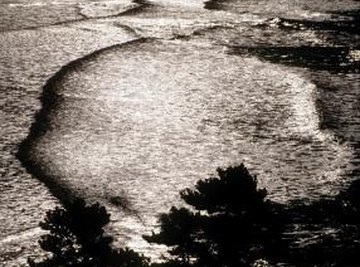

The moon's gravitational field is so strong that it affects the Earth, most notably the water in the oceans. The side of the Earth that is closest to the moon will have a distinct bulge. The rise and fall of the ocean level results from the moon's gravitational field pulling as it moves in orbit around the Earth.
Tide Levels
Tides are the rise and fall of the ocean water level at any given place. For six hours, a tide will rise on the beach. Then for six hours, the water level will recede into the ocean. Because oceans are liquid, their bulge is more obvious than the land bulge.
High Tides
The side of the Earth facing the moon will have a tidal bulge called the direct tide. Similarly, on the opposite side of the planet, the ocean will also be bulging. This is called the opposite tide, and it happens because the inertial force of the Earth exceeds the gravitational force of the moon at this location. Therefore, high tides occur simultaneously on the the opposite sides of the Earth.
Low Tides
Low tides are the receding waters between the high tides. In some places, low tide can be only a few feet, while in others the ocean can recede much farther. High and low tides both appear two times each in a 24-hour day, but since the moon rises 50 minutes later each day, the tide cycles will differ by the same 50 minutes daily.
Spring Tides
The phases of the moon also affect tides. When the moon is at its full or new moon phase, high tides are at their highest, while low tides are lower than usual. Called spring tides, these tides occur when the sun, moon and the Earth all line up. The added gravity of the sun can make the oceans bulge more than at other times.
Neap Tides
During the moon's quarter phases, the sun pulls against the moon's gravitational pull instead of with it. During these tides, the result is the lowest high tide and the highest low tide -- in other words, the least extreme difference between high and low tides. This is called a neap tide.
Too Close for Comfort
If the moon is at perigee, or the closest point in its orbit around the Earth, the tides can also be affected. Combined with a full or new phase, a moon at perigee can produce the highest and lowest tides of all. Scientists can easily predict these highest of tides so that warnings can be issued for possible coastal flooding.
References
About the Author
Susan King is a teacher with 27 years experience with all ages, grade levels and ability levels, including teaching in China. She has written a book, "The Road to Rebecca," about adopting from China. She graduated from Texas A&M University. She also has a ThM from Colorado Theological Seminary in Christian Counseling and recently received her PhD.
Photo Credits
Jupiterimages/Photos.com/Getty Images