
How Do Sapphires Form?

Sapphires have long been appreciated for their beauty and valued for centuries. They can be found gracing England's crown jewels. Pope Innocent III once decreed that "...the ring of a Bishop should be made of pure gold and set with an unengraved sapphire...." Buddhists, who call the sapphire the "stone of stones," believe it produces a desire for prayer, that it creates tranquility and spiritual enlightenment. Indeed, the sapphire has had an impact on human history.

  1. The Multicolored Sapphire

    • Sapphires come in more colors than blue. Yellow sapphires are mined in Australia. Green sapphires come from Queensland. From Sri Lanka's gem-bearing gravels can be found sapphires in hues of pink, yellow, orange (a rare color), violet and gemstones with two or more colors. Although the gemstone does come in red, that variety is not called a sapphire but a ruby. Yet gem dealers prize sapphires of a cornflower blue variety above all. Such stones, with a velvet depth to them, mined in Kashmir, are the most sought after due to their rarity.
      Other valuable sapphires come from Cambodia, Burma, Thailand and Tanzania. From Montana are mined a dark blue sapphire with a distinctive metallic sheen. Sapphires can also be found in Brazil, Kenya, Nigeria, Malawi and Colombia.
      Truly colorless sapphires are rare but are found in Sri Lanka, as are cloudy, milk-colored ones, which are called "geuda." Heat treatment is used to change the geuda into a blue stone.

    Mineral Makeup

    • The sapphire (and ruby) are actually corundums. Like most gemstones, the corundum is a colorless mineral formed from aluminium oxide (Al2O3). As with most gemstones, coloring is the result of "impurities" found in the mineral. Titanium and iron impurities produce the sapphire's familiar blue hue. Sapphires form in feldspathoid-bearing igneous rocks undersaturated with respect to silica. They can also form in recrystallized limestone and high-grade metamorphic rocks that are poor in silica and rich in aluminum. This includes marbles and some mica schists.

    Crystal Structure

    • Sapphires have a trigonal crystalline structure with a hardness of 9. For comparison, diamonds have a hardness of 10, which makes sapphires the second hardest gemstone. Sapphire's hardness, in part, results from the strong and short oxygen-aluminum bonds. The bonds draw the atoms close, making the crystal very dense.
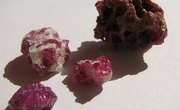
      A gemstone is actually a crystal intrusion in igneous rock. Perfect sapphire crystals form (or grow) in a hexagonal system of bi-pyramids. Picture six-sided pyramids formed base to base. Because of weathering (usually water worn), the crystals that are found are often more barrel shaped, the points having worn off.

    How Minerals Form

    • Minerals are solid crystalline substances that form by natural and normally inorganic processes. Minerals also have distinct chemical compositions and crystal structure. Sapphire's composition is aluminum and oxygen, formed in hexagonal bi-pyramids. But it began as disorganized atoms.
      Through a complex series of chemical, phase reactions, the aluminum and oxygen atoms are tightly organized in a periodical or homogeneous fashion. From the onset, when the first atoms bond, the mineral attempts to achieve equilibrium with its environment. As such, any environmental change--a change in pressure, temperature, acidity, etc.--alters the inner organization of the forming mineral crystal. This causes flaws, structural defects and inclusions of other minerals.
      The crystallization process is divided into two phases--nucleation and growth. Nucleation is that initial formation--a nucleus--from which the crystal will ultimately form. A nucleus is created from randomly scattered materials of a mineral into several joined unit cells. For a gemstone, this occurs on the surface of an impurity
      --titanium and iron in the case of sapphires. Growth is the process by which the mineral adds successive layers of matter--i.e., adding additional row of atoms. If the conditions for growth are not present, the nucleus can break up.
      In igneous environments, pegmatites contain many rare minerals including corundum. The growth of the corundum (sapphire) oxide is helped by the fluidity of the pegmatites' gas-filled environment. In metamorphic environments, minerals are formed by solid-state transformations at temperatures and pressures different from those that formed the original mineral. Among the oxides, corundum and rutile can form. A rutile inclusion in corundum produces an asterism (the six-rayed starburst effect) in a sapphire cabochon.

    Synthetic Sapphires

    • Since the late nineteenth century, sapphires have been produced synthetically, grown in labs. By the early twentieth century, synthetic sapphires have been available in commercial quantities. In 1902, Auguste Verneuil (a Frenchman) exposed powdered aluminum oxide and coloring material (impurity to produce red) to a blowtorch flame, thus producing a synthetic ruby. The Verneuil method has likewise been applied to produce colorless sapphires (called diamondite) since the 1920s.

Related Searches:

Comments

You May Also Like

  • How to Polish Round Star Sapphires

    Round star sapphires make desirable jewelry stones because of their unusual properties. These gems are round in shape, and have a naturally...

  • How to Heat Treat Sapphires

    True, natural sapphires are completely colorless. The presence of trace chemicals provides color through the natural process of heat and pressure. The...

  • How Do Microcalcifications Form?

    Microcalcifications form for many different reasons. These mineral deposits may form because of a blocked milk duct, a condition known as mammary...

  • How to Identify Sapphires

    Sapphires are among the most beautiful and most precious gems in the world. They come in a wide spectrum of colors, the...

  • How to Choose High-Quality Sapphires

    When Prince Charles proposed to Lady Diana Spencer, he gave her a sapphire ring, which symbolizes faithfulness. While the spell didn't work...

  • What Do Sapphires Represent?

    Sapphires are a gemstone commonly mined in Africa, Asia and Australia. They are one of four precious gems that occur in nature,...

  • History of Sapphires

    Sapphires are revered for their deep blue color, but can also be found in such shades as cornflower blue, pink and even...

  • How to Get an Eevee in "Pokemon Sapphire"

    Eevee, the Evolution Pokemon, is not easily obtainable in "Pokemon Sapphire" for the Game Boy Advance. In fact, the only way to...

  • How Do I Tell the Quality of a Blue Sapphire?

    Blue is the most popular and well-known color in sapphires. Quality in colored gemstones is judged in terms of factors such as...

  • How to Identify Minerals

    There are many types of minerals, with several bearing a strikingly similar appearance to each other. Some minerals have a higher market...

  • How Do I Install Mineral Wool Insulation in Floor Joists?

    Floor joists are horizontal elements spanning from one wall to another. They are beam-like structures that support a floor. However, unlike beams,...

  • What Is a White Sapphire?

    White sapphire is a variety of the gemstone sapphire that is often used as a diamond substitute because it costs less and...

  • Difference Between Natural & Lab-Created Sapphires

    The main difference between a natural and a lab-created sapphire is its origin. Both are created using identical materials and have the...

  • How to Grade Sapphires

    Grading sapphires is very similar to grading others gems. The common color range for sapphires consists of primarily blues, yet sapphires can...

  • Types of Sapphires

    Types of Sapphires. Sapphire---the September birthstone---is a highly prized gemstone traditionally found in various shades of blue, but is also available in...

  • How to Measure Clarity in Sapphires

    Sapphires, prized for their beauty, are gemstones from the mineral family corundum. Although sapphires are most commonly associated with deep shades of...

  • How to Dissolve Mineral Deposits

    Mineral deposits occur when a mineral has built up around any given item. The most common areas to find mineral deposits are...

  • Why Don't Crystals Form on the Earth's Surface?

    Comments. You May Also Like. How Do Crystals Form in Caves? Crystals can develop in a vast range of shapes and sizes,...

  • Minerals vs. Vitamins

    Whether it's building new blood cells, repairing a wound or sending nerve signals, the body operates at the cellular level with complex...

  • How to Study Sapphires

    Sapphires and rubies both come form the same mineral, known as corundum or natural aluminum oxide. When this mineral is found in...

Related Ads

Featured