
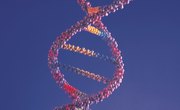
The DNA double helix molecules look like a twisted ladder and the rungs or steps are made up of nitrogenous bases that form the genetic code for all living organisms. There are four bases in all, two of them the purine bases and two the pyrimidine bases. A rung of the ladder can be made up of one purine and one pyrimidine base.
The bases have a molecular structure that allows the two types of bases to form a weak link called a hydrogen bond. It normally keeps the two DNA strands together but it can unravel to allow copies of the code to be made for protein production and for the reproduction of the cell. This intricate mechanism forms the basis of all life on earth.
TL;DR (Too Long; Didn't Read)
TL;DR (Too Long; Didn't Read)
The purine and pyrimidine bases of the DNA molecule form the bonds that encode the genetic information of all living things. The two purine bases are adenine and guanine while the pyrimidine bases are thymine and cytosine. Adenine bonds only with thymine and guanine bonds with cytosine, these bonds forming the rungs of the DNA ladder.
How Purine Bases Form Part of the DNA Double Helix
The ladder-like DNA double helix is made up of six molecules. The rungs of the ladder or the steps are made up of the nitrogenous purine bases adenine and guanine as well as the nitrogenous pyrimidine bases thymine and cytosine. The rails on either side are alternating molecules of the sugar called deoxyribose and a phosphate. The sugar has the nitrogenous base molecule attached to it and the phosphate is a spacer between the rungs of the ladder. A basic unit of the DNA chain is one phosphate molecule and one sugar molecule with a nitrogenous base molecule attached to it.
Each purine base can only form a bond with one pyrimidine base, adenine with thymine and guanine with cytosine. As a result, there are four possible combinations: adenine-thymine, thymine-adenine, guanine-cytosine and cytosine-guanine. The genetic information of all living things is encoded in DNA using these four combinations.
Pyrimidine and Purine Bases Govern Cell Processes
The purine and pyrimidine bases form hydrogen bonds to keep the two rails of the DNA molecule together. Adenine and thymine form two hydrogen bonds while guanine and cytosine form three. Hydrogen bonds are electrostatic forces between electrically charged parts of a polar molecule rather than chemical bonds. As a result, they can be neutralized and the DNA can separate into two strands at a particular location.
When a cell needs specific proteins, the DNA strands governing production of the proteins separate and RNA molecules copy one strand. The RNA copy of the instructions is then used in the cell to produce amino acids and the required proteins. The cell uses RNA to copy the DNA genetic code and then uses the coded instructions to make the proteins it needs.
Pyrimidines and Purines in DNA Control Cell Division
When a living cell is ready to divide into two new cells, the two sides of the DNA molecule separate by neutralizing the hydrogen bonds linking the purines and the pyrimidines. Instead of using RNA on a section of the DNA ladder, the whole ladder separates and new nitrogenous bases are added to each side. Because each base will only accept one partner, each side becomes a full and exact duplicate of the other.
For example, if a DNA bond was an adenine-thymine link, one side has the adenine molecule and the other side has the thymine molecule. The adenine attracts another thymine molecule and the thymine attracts an adenine molecule. The result is two identical adenine-thymine bonds in two new strands of DNA.
The two purine nitrogenous bases of DNA are essential for all cell protein production and for cell division. The cell division made possible by the DNA copying mechanism forms the basis for all growth and for all forms of reproduction of living organisms.
References
About the Author
Bert Markgraf is a freelance writer with a strong science and engineering background. He has written for scientific publications such as the HVDC Newsletter and the Energy and Automation Journal. Online he has written extensively on science-related topics in math, physics, chemistry and biology and has been published on sites such as Digital Landing and Reference.com He holds a Bachelor of Science degree from McGill University.