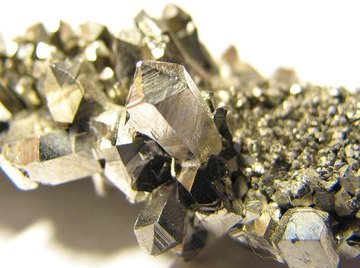

Niobium (Nb) is a rare metal, a transitional element and the 33rd most common element on the earth's crust. Niobium is important to modern society because niobium alloys are used frequently in both steel-based construction and scientific equipment, especially equipment designed to leave the earth.
Basic Facts
Niobium is abbreviated Nb, and is element number 41 on the periodic table. It has an atomic weight of 92.90638 and a specific gravity of 8.57. Niobium has a melting point of 2750 K (2477°C or 4491°F), and a boiling point of 5017 K (4744°C or 8571°F). Niobium can have a valence of +2, +3, +4, or +5. Niobium is a soft, silvery-gray, ductile metal, which remains solid at room temperature (20°C).
Discovery
In 1734, Connecticut Gov. John Winthrop the Younger discovered a new mineral and named it Columbite. He sent it to the British Museum in London, where it remained until 1801 when Charles Hatchett analyzed it and found that the Columbite contained an unknown element. Hatchett could not isolate the element, but named it columbium. Eight years later, William Hyde Wollaston theorized that columbium was actually the element Tantalum. (This was an easy mistake to make, since tantalum and niobium are very similar.)
Re-Naming
In 1844, Niobium was rediscovered when Heinrich Rose produced two new acids from samples of Columbite and Tantalite. The acids were very similar, and so Rose named one of them Niobic acid and one of them Pelopic acid. (Niobe and Pelops are the two children of Tantalus in Greek mythology.) In 1864, Christian Wilhelm Blomstrand managed to isolate the element in Niobic acid, and thus the metallic form of Niobium was finally proof of the element Niobium, the name used for the element once called columbium.
Chemical Compounds
The two main compounds made from Niobium are niobium nitride and niobium carbide. Niobium nitride is a combination of niobium and nitrogen, and is a compound that serves as a superconductor at low temperatures. Niobium nitride is often mixed with other conductive metals, such as aluminium, tin and titanium, to make even more superconductive material. Niobium carbide is a combination of Niobium and carbon, and is a hard material with high refractivity.
Functions
Niobium Carbide is used in high-strength steel alloys to increase the strength and resistance of the steel to heat and corrosion. Niobium Nitride, and superconductive wires made from it, are often used to create superconductor magnets for use in MRI equipment, mass spectrometers, and other scientific applications. Niobium is sometimes used as a protective coating, sometimes used in jewelry, and sometimes used in the creation of lenses.
Potential
Niobium's properties make it an attractive material for capacitors and may one day replace tantalum. The superconductive magnets made from Niobium have a number of promising potential uses, especially in the field of energy efficiency. Power storage devices and transformers could be made more effective with niobium and allow for easier transmission of electric power. Looking further into the future, electric motors that run on magnets or even magnetic levitation devices might be possible, the combination of which might allow for a MagLev train.
References
About the Author
This article was written by the CareerTrend team, copy edited and fact checked through a multi-point auditing system, in efforts to ensure our readers only receive the best information. To submit your questions or ideas, or to simply learn more about CareerTrend, contact us [here](http://careertrend.com/about-us).
Photo Credits
Commons.wikimedia.org