

How to Adjust Lycra Sewing Machine Tension

The tension setting on your sewing machine can make all the difference when you are sewing with knit fabrics such as lycra. If the setting is too tight, the threads will break and cause a huge knot of tangled thread to gather on the fabric.
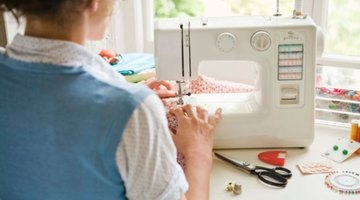
If the setting is too loose, the stitches won’t be formed properly and your seam won’t be secure. Using a stretchy stitch setting and the right tension settings for your sewing machine are the keys to sewing with knit fabrics.
Things You Will Need
- Ballpoint sewing needles
- Owner’s manual for your sewing machine
- Small screwdriver
-
Remove your regular sewing needle and replace it with a ballpoint sewing needle. Knits are made from long yarns that can be cut by regular needles. Use a needle size appropriate for your fabric; consult your owner’s manual for proper needle sizes for your machine.
-
Cut a 12-inch by 12-inch piece of fabric on which to test your stitches.
-
Set your sewing machine to a stretchy stitch, such a zigzag stitch or long stretch stitch. Consult your owner’s manual for instructions regarding how to set your machine.
-
Set your upper tension to between three and four, which is a neutral tension setting.
-
Sew a test line of stitching along one edge of your fabric.
-
Remove the fabric from the sewing machine and inspect your line of stitches. The seam should have even stitches that look the same on both the front and the back. There should be no puckering, gathering or missed stitches. Gently pull on each end of the fabric. The stitch should gently stretch without breaking. If your test seam has any of these issues (and test seams often do), you need to adjust your tension.
-
Move the upper tension up to four, sew another line of test stitching and re-inspect your stitches. Continue adjusting your sewing machine's upper tension up until you find a setting that makes perfectly straight, stretchy stitches that don’t break. If you can’t find this setting by turning your tension up, start turning your tension down. This may take several attempts until you find the perfect tension setting. If you still cannot accomplish a perfect stitch, you may need to adjust the lower tension.
-
Adjust your lower bobbin tension by turning the screw located on the bottom of the bobbin case ¼ of a turn to the right. Sew a test stitch to check your tension and continue adjusting the bobbin screw ¼ of a turn at a time, first to the right and then to the left, until you achieve a perfectly even and straight, stretchy stitch.
The Drip Cap
- The tension setting on your sewing machine can make all the difference when you are sewing with knit fabrics such as lycra.
- Using a stretchy stitch setting and the right tension settings for your sewing machine are the keys to sewing with knit fabrics.
- Remove your regular sewing needle and replace it with a ballpoint sewing needle.
- Knits are made from long yarns that can be cut by regular needles.
- Move the upper tension up to four, sew another line of test stitching and re-inspect your stitches.
- Continue adjusting your sewing machine's upper tension up until you find a setting that makes perfectly straight, stretchy stitches that don’t break.
References
Writer Bio
Based in the Pacific Northwest, Arin Bodden started writing professionally in 2003. Her writing has been featured in "Northwest Boulevard" and "Mermaids." She received the Huston Medal in English in 2005. Bodden has a Master of Arts in English from Eastern Washington University. She currently teaches English composition and technical writing at the university level.
Photo Credits
- Jupiterimages/Polka Dot/Getty Images
- Jupiterimages/Polka Dot/Getty Images
More Articles

