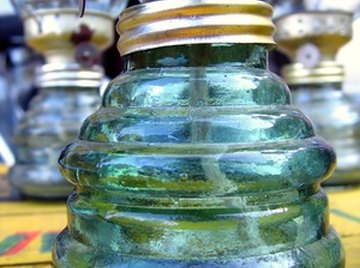

Kerosene is a combustible liquid hydrocarbon used as a jet engine and heating fuel. In the 1800s, kerosene was very common in lamps, sometimes called hurricane lamps. Kerosene comes in two grades, based on sulfur content. The sulfur content of kerosene is important because it forms harmful pollutants when burned. Apart from sulfur content, the two kerosene grades have identical properties.
1-K
One-K grade is the purest form of kerosene. It's clear or slightly yellow, with a maximum sulfur content of 0.04 percent by weight. Due to its low sulfur content, it's possible to burn 1-K kerosene without a flue to remove combustion byproducts from the room. However, you should avoid red dyed 1-K kerosene, specially indoors, as it has more impurities and can produce more fumes than its clear version.
2-K
Two-K grade kerosene can contain up to 0.30 percent sulfur, which is a much higher level than 1-K grade kerosene. Two-K kerosene must only be burned in appliances with a flue, as the fumes released can be very harmful if inhaled. In the case of heaters, 2-K must not be used also because it affects proper fuel wicking, creating the need for frequent wick cleaning and maintenance that can produce a fire or explosion hazard.
Safety Issues
Always observe the kerosene grade before buying it. Although 1-K is often has a lighter color than 2-K, you should always read the label to make sure you are buying the right one. When buying a kerosene appliance, such as a heater, choose from those that were tested and listed in accordance with Underwriters' Laboratories (UL) Standard 647. A heater should cool for a minimum of 15 minutes before refueling. This operation should happen in well-ventilated area, away from ignition sources.
Properties of Kerosene
The boiling point of kerosene lays between 302 degrees Fahrenheit and 572 degrees Fahrenheit. Kerosene's melting point is -4 degrees Fahrenheit and its relative density is 0.8, which means that it is less dense than water. As kerosene is also insoluble in water, it floats on it when the two substances are mixed. Kerosene can autoignite when the temperature reaches 428 degrees Fahrenheit.
References
- "When All Hell Breaks Loose: Stuff You Need to Survive When Disaster Strikes"; Cody Lundin; 2007
- MadSci Network: Are there different grades of Kerosine?
- "Petroleum Supply Annual 2004"; U.S. Department of Energy; 2005
- National AG Safety Database: Unvented Portable Kerosene Heaters - Safety Considerations
Photo Credits
detail of a kerosene lamp image by Yali Shi from Fotolia.com