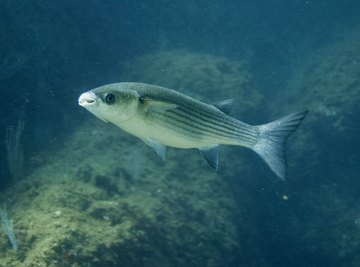
Mullets are ray-finned fish and have been a source of food for thousands of years. There are 80 species in the mullet family. Mullets are characterized by their small, triangular mouths, the lack of a lateral line and two separate dorsal fins.
Striped or Black Mullet
The striped or black mullet is found in freshwater, as well as in coastal marine water that is warm, particularly in Florida. The fish was plentiful in the Nile River during ancient Rome. Native chiefs of the Philippine and Hawaiian islands liked the fish so much that they had fish ponds built in which to raise mullet fish. This fish is sometimes called the "flathead" mullet.
Jumping
People sometimes refer to this fish as the "happy" or "jumping" mullet because they skip along the surface of the water, seemingly with great excitement, and often leap out of the water. The mullet actually jumps up and out of the water. This is done, it is believed, to increase the volume of oxygen in the mullet's body. When mullets are in water that has lower levels of oxygen, they jump more often.The mullet is built for speed.
Appearance
The mullet has an elongated body, but it is round like a tornado. Its body is covered with blue-gray or olive-green scales that are large and situated on the fish’s upper sides and back. The scales fade in color to shades of silver on the belly and lower sides. It is called a "striped mullet" because of the very noticeable horizontal black stripes on its side. The scales on the sides are large and have dark centers that give the perception of dark, horizontal stripes. The striped mullet has a small mouth and head, and the teeth are closely set in the jaws. The mullet can be as long as 2 1/2 feet and weigh between 2 and 3 lbs., although they have been known to be as large as 6 lbs.
Food
Mullets like to eat plankton, algae and vegetation, and they take on the flavor of their surroundings. If the mullet is swimming polluted waters, it is not edible. Called "bottom feeders," striped mullets scrape material from rocks using their lower jaw that is shaped like a spade. They also pick up material from the sea floor and use their gill rakers and teeth to strain animal matter and digestible plants.
Characteristics
The first of the mullet's two dorsal fins has five spines, whereas the second of the dorsal fins has eight soft rays. The striped mullet’s pectoral fin is short and its tail fin is forked.
Mating
When the striped mullet is mating, the females and males slowly swim into the current. The males surround the females and knock into them during the convoy. Eggs are externally fertilized and then spread.
How to Catch Them
Striped mullets make a tasty dish. Mullets are caught with small treble hooks or cast nets, rather than hooked baits or lures. If the striped mullet is caught with a lure, it fights for its life.
Where to Find Them
This fish is found in warm seas and oceans around the world. This is a coastal, inshore fish that swims into rivers and estuaries, preferring mud, sandy bottoms and locations where there is a lot of vegetation. The mullets travel in large schools. The best months to fish for mullet are from April to November, but September is the ideal month.
About the Author
Cindi Pearce is a graduate of Ohio University, where she received her bachelor’s degree in journalism. She completed both the undergraduate and graduate courses offered by the Institute of Children’s Literature. Pearce has been writing professionally for over 30 years.