
What Is the Definition of Oil Drilling?

What Is the Definition of Oil Drilling? thumbnail
What Is the Definition of Oil Drilling?

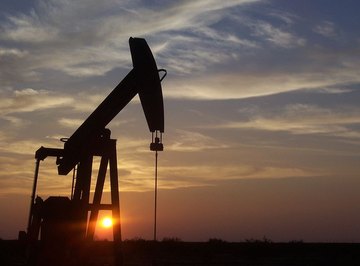
Oil drilling is the process of perforating the earth's surface and rock layers to extract fossil fuels, or oil, for energy production. Oil can be found all over the world, and it is drilled in many countries. Oil is formed from the organic decay of plants and animals that existed millions of years ago. In the absence of oxygen between the earth's layers, the decaying process of this organic waste eventually lead to oil production.

  1. History

    • China is credited with being the first in the world to have drilled for oil. Using bamboo poles in an elaborate drilling apparatus, the ancient Chinese were able to extract oil from depths of over 800 feet. In the 8th century, petroleum was actively extracted in the Middle East. Western Europe learned and benefited from the sciences of oil extraction and distillation from the Muslim scientists in Moorish Spain. The scientists of Islamic Spain developed many methods of processing petroleum for many products, such as distillation to extract kerosene and other chemical methods for oil production.

    Identification

    • Horizontal Oil Drilling

      Identifying the locations of new oil digs employs the skills of geologists, who use seismic technology to analyze the earth's contents. Oil companies expect geologists to find ideal locations for oil traps, which must meet their standards for source rock, reservoir rock, as well as entrapment.

      Geologists use several methods to locate an ideal oil location. They commonly use seismology, which sends shock waves through the earth's rock layers. Shock waves are sent through the earth by a thumper truck, explosives, or a compressed-air gun and send back readings of oil content beneath the surface. They also employ satellite images to examine the earth's surface. Sensitive gravity meters and magnetometers, as well as sniffers are often used in combination to locate an oil source below the earth's surface. Once oil is located, GPS technology is used to mark its location for drilling.

    Features

    • There are several steps to the oil drilling process. Sites are assessed for the area boundaries, legal obligations, as well as environmental responsibilities. The land is then cleared, leveled and prepared for drilling.

      The first step is to make sure there is a water source, and to drill a reserve pit for drilling debris. The site is then prepared to support the drilling rig.

      The second step is to drill a starter hole, which reaches the area just above the oil location. The rig is prepared to drill into the oil site by lowering the drill bit and pipe into the hole. The drilling process begins when the kelly and turntable is activated; drill pipes are extended into the hole. Once they reach the level just above the oil store, a mold is made out of cement to create a well. This will hold the walls in place and prevent oil mixing with rock debris.

      This process is repeated until the digging team reaches the oil source. The equipment is then removed, then a series of tests are performed to measure the rocks, the pressures, and to take rock samples.

      The next step is to prepare for the oil extraction, which can be an explosive occurrence. To prevent a blowout, the well is cracked. Then the oil flows into the casing. Holes are made into the casing for tubes to be inserted to extract the oil.

      An apparatus called a "Christmas tree" is attached to help the workers control the flow of oil into the well. Once this is accomplished, the oil rig is removed and replaced by oil production equipment.

    Types

    • There are several different methods employed for oil drilling. Auger drilling uses a screw-type mechanism to break the earth's surface for oil. Air core drilling utilizes steel blades, air injection and blasting, while percussion rotary air blast drilling uses a hammering method of digging for oil.

      There is also the cable tool method, which uses a large cable to crush rock that is removed to keep digging to the oil, and the diamond core drilling method that uses actual diamonds to make circular cuts through the rock.

      Other methods of oil drilling include reverse circulation (RC) drilling, which uses a hammer method to break the earth and a cyclonic force to remove the crushed rock; sonic drilling, which resonates sonic vibrations to break the rock; direct push rigs which utlitize hydraulic hammers and cylinders to collect samples; and hydraulic-rotary drilling which involve the use of rotating hollow pipes that drill through the earth's rock layers, while pumping a mud substance to cool and control the drilling process.

    Warning

    • There are many environmental and health concerns associated with massive oil drilling. Oil spills have occurred many times, damaging the ecology of the air, land and water of that area. Utilizing seismic technologies to assess areas for new digs have disoriented land and sea animals, causing many whale beachings and hearing loss in land animals. New digs also claim more natural habitats and displace its wildlife. Oil drilling and disposal of its waste and by-products also has had a tremendous impact on the air and water qualities, which have been associated with health concerns, such as birth defects and other heatlh issues. Drilling for oil is necessary to provide the fuel and energy needed in our society, however, new methods designed with minimal negative impacts on the environment and wildlife will make the extraction of oil more environmentally friendly.

Related Searches:

Resources

  • Photo Credit BBC, Horizontal Drilling

Comments

You May Also Like

Related Ads

Featured