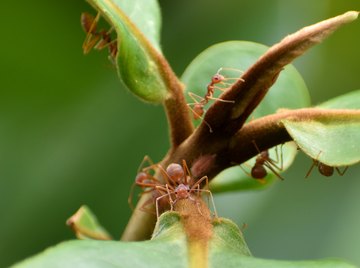
Most people easily recognize ants. After all, these insects are some of the most common six-legged residents in homes and yards. However, when it comes to identifying specific types of ants, the undertaking is more complex.
TL;DR (Too Long; Didn't Read)
TL;DR (Too Long; Didn't Read)
When it comes to identifying types of ants, observe their bodies carefully, looking for color, size, number of pedicels and any notable projections on the thorax.
Characteristics of Ants
One of the most important things to examine when identifying types of ants is body shape. Because they are insects, ants all have bodies that include a head, thorax and abdomen. Unlike other insects, ants have a distinct narrowing between each section of the body. Entomologists call the constriction between the ant’s thorax and abdomen – its “pinched waist” – a pedicel. Upon careful inspection, the pedicel actually comprises one or two spherical nodes. The bulging abdomen below the pedicel is officially the ant’s gaster. Most ants have segmented antennae with obvious bends, called elbows, between the segments. The majority of ants are wingless worker ants, but ants who belong to the reproductive cast have wings they use for swarming during mating season. When it comes to distinguishing between ants and termites, always check for the obviously constricted waist and elbowed antennae since these features are unique to ants.
Types of Ants
Some well-known types of ants include acrobat ants, carpenter ants, fire ants, odorous house ants and pyramid ants.
Acrobat ants (Crematogaster) are medium-sized and have two pedicels and two spines located on the thorax. They are active during the day and tend to raise their gasters in the air when frightened, which gives them the appearance of acrobats.
Carpenter ants (Campanotus) are usually black or brown but can be a combination of black and orange. Worker ants of this type vary in size, but the species is relatively large in comparison with other types of ants. Carpenter ants look similar to acrobat ants but are mostly nocturnal, have only a single pedicel and lack thoracic spines.
Fire ants, or Solenopsis invicta, are best known for their fierce sting and general aggression. They are small, reddish-brown in color and have a double pedicel. It is best to avoid these ants.
Odorous house ants (Tapinoma sessile) are medium-sized and dark in color. These ants have a single pedicel, love sweet things and smell like licorice if crushed.
An ant with red head and thorax and black abdomen is likely a pyramid ant (Dorymyrmex pyramicus). These small ants have a single pedicel and a pyramid-shaped projection on the thorax. Some people consider pyramid ants beneficial insects because they prey on fire ants.
With careful observation, noting the details that distinguish between various types of ants is a straightforward scientific application – and a great party trick for picnics!
References
About the Author
Melissa Mayer is an eclectic science writer with experience in the fields of molecular biology, proteomics, genomics, microbiology, biobanking and food science. In the niche of science and medical writing, her work includes five years with Thermo Scientific (Accelerating Science blogs), SomaLogic, Mental Floss, the Society for Neuroscience and Healthline. She has also served as interim associate editor for a glossy trade magazine read by pathologists, Clinical Lab Products, and wrote a non-fiction YA book (Coping with Date Rape and Acquaintance Rape). She has two books forthcoming covering the neuroscience of mental health.