
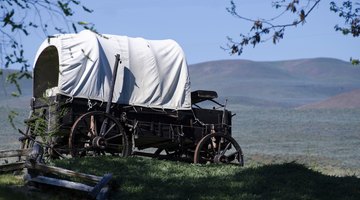


Life wasn't easy for America's pioneers, who migrated westward over rough terrain to settle in rugged, undeveloped areas. Although the pioneers were a diverse group of people with varied background and ethnicities, clothing worn by settlers in the 1840s through the 1860s had many similarities. Rapid changes in weather and the rigors of travel required sturdy, durable clothing. Nothing was wasted and pioneers used old, worn clothing to make quilts or rugs.
Fabrics and Fibers
Although urban dwellers in the early 19th century often purchased ready-made clothing, rural people usually wore home-sewn garments constructed from factory-made cloth in solid colors or a simple print. However, factory-made clothing and fabric wasn't available along the trail or in early Western settlements, and home sewing machines weren't patented until 1846. Most clothing was constructed from hand-spun, homemade cloth made primarily of linen or wool. Early pioneers created colorful fabric dyes from plant parts such as berries, stems, leaves, blossoms, moss, nut hulls and fruit pits. Making clothing was a labor-intensive task performed by women.
Men's Clothing
Pioneer men wore sturdy clothing, including long, straight-legged trousers constructed from brown, black or gray linen, wool or canvas-like fabric. The trousers fastened with buttons because zippers weren't widely available until the early 20th century. Pullover shirts, usually made of linen or wool, had long, full sleeves, buttoned cuffs and long tails that tucked into the trousers. Belts weren't used in pioneer times, so men wore suspenders to keep the loose-fitting trousers in place.
Clothing for Women
Women's garments consisted of dresses made of dark-colored fabrics that didn't show dirt. Although women usually wore long skirts, pioneer women often wore slightly shorter, ankle-length skirts to keep the hems from the mud and dust. The dresses, which were fastened with buttons or hooks, had snug bodices and high necks. Women usually wore at least one petticoat under the skirt. An apron, either pinafore-style or tied at the waist, was worn to keep the dresses clean.
Children's Clothing
Young pioneer boys wore long, loose-fitting gowns, much like little girls. Once they were potty trained, some little boys wore short pants in the summer. After they reached the age of about 8, they dressed much like their fathers. Girls dressed much like their mothers, although young girls wore loose, calf-length dresses until they reached their mid-teens.
Headwear and Footwear
Pioneer men, women and children wore leather boots with flat soles, often with tops that turned down. During the winter, people kept warm by wearing wool or linen scarves and wool socks. Men's coats were similar to coats worn today; however, they were looser and often constructed without collars. Women wore shawls or cape-like garments. Headwear for men usually consisted of wide-brimmed hats often made of felt. Women wore bonnets outdoors to protect their faces from sun and wind. Lightweight caps worn under the bonnets were also worn indoors. However, the caps fell out of fashion by the 1840s.
Related Articles





References
Writer Bio
M.H. Dyer began her writing career as a staff writer at a community newspaper and is now a full-time commercial writer. She writes about a variety of topics, with a focus on sustainable, pesticide- and herbicide-free gardening. She is an Oregon State University Master Gardener and Master Naturalist and holds a Master of Fine Arts in creative nonfiction writing.