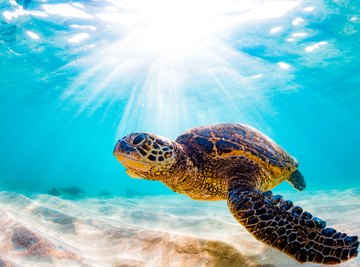

The oceans are home to a wide variety of species of all shapes and sizes — from the tiny stout infantfish, to the shelled sea turtles, to the 100-foot-long blue whale. Many species in the ocean have evolved to eat plant matter, rather than meat — some species eat both. These different groups are called herbivores, carnivores, and omnivores, respectively. Herbivores in the ocean can be reptile, fish or mammal. Some of them provide food for carnivorous or omnivorous predators of the deep.
Green Sea Turtles: Prolific Plant-eaters
The green sea turtle has an incredible range of habitation, stretching from Finland to the tip of Cape Horn in Africa, though it generally prefers tropical and subtropical waters. The green sea turtle has a wide smooth shell, or carapace, and is named for the greenish color of its skin rather than its shell, which normally is brown or olive in color. Green sea turtles eat seagrasses and algae, though juveniles snack on crabs, sponges, and jellyfish. In the wild, they can live up to 80 years and grow up to five feet long. They can weigh as much as 700 lbs. Once mature, it is the only sea turtle that is strictly herbivorous.
Manatees: Cows of the Sea
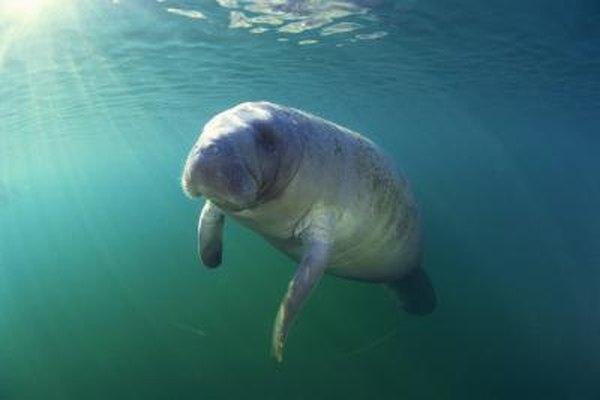
Manatees, sometimes called sea cows, move at a languid pace through coastal waters and rivers. Despite their bulk, they are graceful and powerful swimmers. Manatees use their tails to glide along at about five miles an hour, though they can manage 15 miles per hour for short distances. While they prefer to travel alone or in pairs, groups of about a half dozen are sometimes seen together. Their diet consists of water grasses, weeds, and algae. Typically, manatees eat a 10th of their weight every 24 hours. Unlike seals or sea lions, manatees never leave the water. When resting, they can remain below the surface of the water for up to 15 minutes. While swimming, they surface to breathe every few minutes. Geographic location distinguishes the three different manatee species. West Indian manatees primarily inhabit the southern waters of the United States but can range as far south as Guyana, South America. Amazonian manatees only live in the waters of the Amazon River. The West African manatees range along the western coastal waters of Africa from the Senegal River in Senegal to the Kwanza River in Angola.
Dugongs: Oceanic Grazers
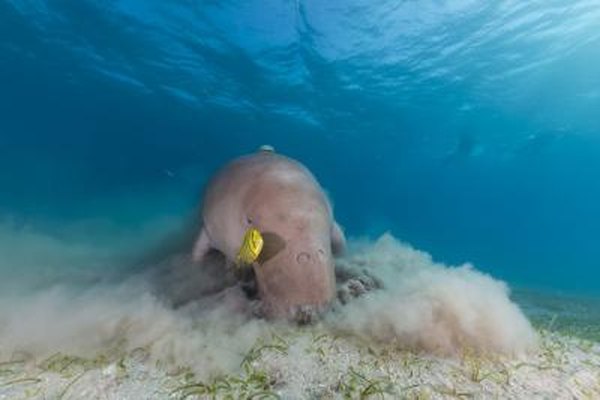
Dugongs are related to manatees, which are both endangered and protected animals. These slow-moving herbivores graze on underwater grasses, rooting them out with bristled, sensitive snouts and chomping them with rough lips. Found in warm coastal waters, these enormous vegetarians are found from East Africa to Australia. Adults weigh between 500 and 1,000 lbs. They can grow up to 10 feet long with an average lifespan of 70 years. Like other sea mammals, dugongs can stay underwater for short periods of time until they must resurface to breathe. The dugong can stay underwater for up to six minutes. Though they tend to be found alone or in pairs, when dugong herds gather, they can number in the hundreds.
Parrot Fish: Algae-eaters
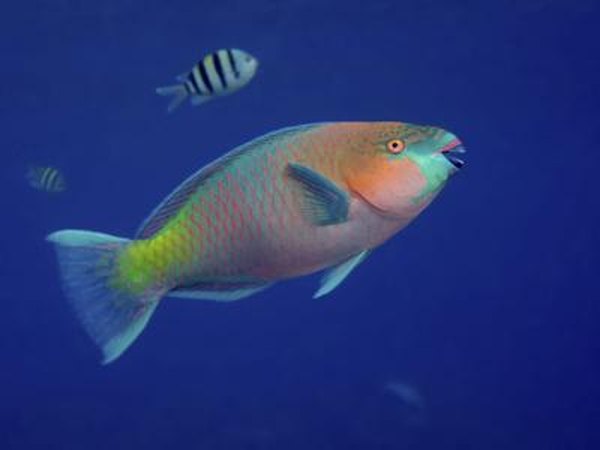
Parrotfish are colorful and unique. They range in size from one to four feet. Of the 80 identified species, all can change their gender as well as their coloration and patterns. This ability makes it difficult for ocean biologists to classify the species. Parrotfish are algae eaters. They obtain the algae by ripping small chunks of coral from a reef. The fish's grinding teeth, located in its throat, pulverize the coral. The teeth allow the fish to extract the algae from the center of the polyp inside.
Herbavores Across the Seven Seas
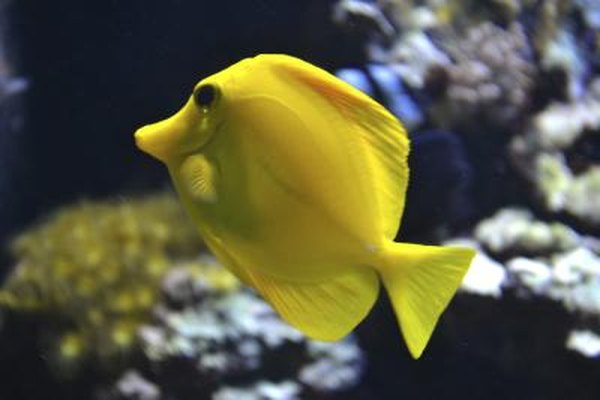
Many other herbivores thrive among the fish population. The surgeon family of fish includes Achilles black-spot, blochii, blue hepatus tang, blue tang, brown, chocolate, convict tang, eyestripe, fowleri tang, Japan, lavender tang, powder blue tang, sailfin desjardinii tang, scopas tang and yellowtail tang. The blenny family includes bicolor, black, black sailfin canary, combtooth, flametail, lawnmower, lined, Midas, starry, striped and tailspot. The foxface family is comprised of the bicolor, foxface and magnificent. Unicornfish include the blond orangespine, orangespine and, whitemargin. Other herbivores include the Japanese angelfish, yellow bloth rabbitfish, and tilapia.
References
About the Author
Bjorck DiMarco has been the Senior Editor at an independent publishing house since 1994. She holds advanced degrees in teaching, English and creative writing, graduating summa cum laude from Tufts University and the University of Massachusetts. DiMarco has also worked in construction, fine woodworking, graphic design and theoretical mathematics.