How Much Does Nuclear Energy Cost?

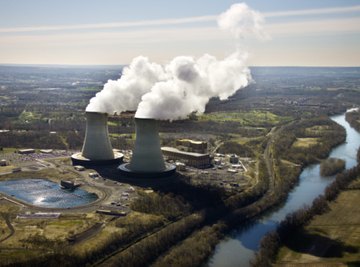
Fifteen percent of the world's electricity comes from nuclear power, with some countries, such as France and Japan, being heavily dependent upon it. Although less used in the U.S. since the 1970s, high oil prices and concern over global warming have renewed interest in nuclear energy. However, a key issue in the public debate on whether to build more nuclear reactors to mitigate U.S. carbon emissions and to meet future electricity needs is whether nuclear energy is economical.

  1. Function

    • Nuclear energy is created through a mechanism called a reactor. The power source is the heat produced by a controlled nuclear fission chain reaction, either of uranium or plutonium. This reaction involves an element such as uranium or plutonium being struck by a neutron and splitting. The result of the fission of these large atoms is the creation of new, smaller atoms as byproducts, radiation and more neutrons. Those neutrons speed out and strike other uranium/plutonium atoms, creating a chain reaction. The chain reaction is controlled by neutron moderators, which vary depending on the design of the reactor. This can be anything from graphite rods to simple water.
      Once the heat has been released, a nuclear reactor produces electricity in exactly the same manner as any other thermal-based power plant. The heat converts water into steam, and the steam is used to turn the blades of a turbine, which runs the generator.

    Significance

    • One element in how much nuclear energy costs is the construction of the nuclear power plant itself. These power plants require much longer to build than conventional thermal power plants and are not generating revenue during the lengthy construction phase. The smallest nuclear power plants are often larger than even a middling conventional thermal plant, making them more inflexible in terms of meeting the needs of an area that doesn't consume much power. Also, the liberalization of the electricity market makes it more difficult or impossible to negotiate the long-term generating contracts that would guarantee a return on a nuclear power plant's high construction costs. It is these costs that prompted the tax breaks for new nuclear groundbreaking in the Energy Policy Act of 2005.
      Another nuclear energy issue is the cost of fissile materials. Uranium and plutonium are commodities, just like oil, coal or natural gas, and they too experience price fluctuations. At times, fissile materials have been more expensive than fossil fuels.

    Warning

    • Unlike other power plants, nuclear facilities require security against attack or sabotage. This includes screening the workers. Providing security is an added cost that a natural gas-fired plant, for example, does not have to pay.

    Considerations

    • Another cost that nuclear power plants must bear that other designs do not is radioactive waste disposal. In the U.S., this is paid for with a 1/10 of a cent per KWH surcharge. However, few studies on nuclear energy compare the cost of radioactive waste disposal to that of cleaning up carbon emissions, a very real issue for the future of oil- and coal-fired power plants. This makes the relative costs of radioactive waste disposal comparable only to truly clean forms of energy, such as hydroelectric.
      A related issue is the ultimate fate of a nuclear power plant, namely decommissioning. An old nuclear facility slated for closure must be dismantled, and its many contaminated components disposed of. The estimated cost for a typical power plant is $300 million dollars. While a similar process must be performed for any power plant that is being closed, other designs produce little if any toxic, contaminated articles to be disposed of, so the costs are substantially less.

    Features

    • Due to the risks of a nuclear accident, nuclear power plants also suffer higher insurance costs than would be the case for any other power plant design. This is true despite the Price-Anderson Nuclear Industries Indemnity Act, in which the U.S. government has promised to cover any nuclear facility insurance claims over $10 billion.

    Types

    • Nuclear power is estimated to cost $59.30/MWH. This is expensive when compared to other means of generating electricity. For example, clean wind power is $55.60/MWH; coal $53.10/MWH; and natural gas $52.50/MWH.

Related Searches:

Comments

  • grammastacie May 28, 2009
    amen! my husband is a senior electrical engineer and my son a reactor operator in the powerhouse, and you have written a very informative article! 5* and recommend.
  • ret71 Apr 19, 2009
    Those statistics come from a well-known, recent study by none other than the U.S. Department of Energy... Dick Cheney's pro-nuclear DOE, I might add. You might consider doing your homework before you shoot your mouth off.
  • bkc9 Dec 10, 2008
    I would love to see how the person arrived at wind power costing less than nuclear power. When you factor in the availability (actual output) or you increase the capacity of the wind installed to match the output of nuclear, there is no way it can compete from a strictly economic point of view. Dispatchers for the national power grid do not consider wind as an available asset. Thus, even where wind is installed, equivalent known assets must be available to account for the lack of wind that can affect an entire region. Wind is still pie in the sky compared to the rock solid history of nuclear.

You May Also Like

Related Ads

Featured