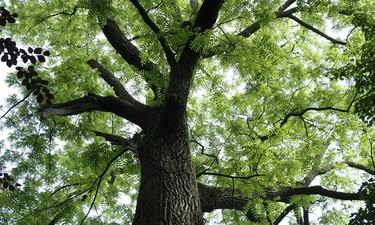
Anyone who has a mature walnut tree in their home orchard has a lot to be thankful for. These are impressive trees, large and vigorous, with long, attractive trunks and wide-spreading canopies. That means that they are both excellent shade trees and produce some of the most popular nuts available. Given the number of years it takes the walnut to start producing nuts, having an adult tree is valuable indeed.
Meet the Walnut Tree
Video of the Day
The walnut tree (Juglans spp.) is an exceptional deciduous tree and definitely not for smaller gardens. Walnut trees can grow to over 100 feet in height with a powerful trunk up to 6 1/2 feet in diameter. However, cultivated trees more often stay about 50 feet tall and wide. Some varieties have smooth, silvery bark, while others have dark, ridged trunks. The leaves, composed of smaller leaflets, are a bright green. The most popular walnut trees in the United States are English walnut (Juglans regia), native to Europe, and black walnut (Juglans nigra), native to North America. The trees can live some 200 years.
Video of the Day
The walnut tree produces much-loved fruit, fleshy green drupes that encase the familiar walnuts. Walnut trees begin producing nuts only after seven to eight years unless they have been grafted, but it takes about 30 years for a tree to reach peak production. A mature tree can produce a lot of nuts every year, between 50 and 80 pounds of nut kernels. The sweet sap of the walnut tree can also be tapped and used to make syrup.
Plant a Walnut Tree
If you are just putting in a walnut tree, you will need to select a planting site and planting method. Once a walnut tree is established, it won't require much help as long as it has a good foundation. Plant your tree in an area with good air circulation and drainage.
Deep, well-worked soil is essential for walnut trees to grow. And all nut trees require fertile soil for good growth. To create the best soil, remove the topsoil and keep it in a separate pile to put in the bottom of the planting hole. Then work the soil to a depth of at least 3 to 4 feet. Walnut roots can be extensive and grow to depths of 15 feet.
For fastest tree growth, dig a planting hole in the worked soil that is twice as deep and wide as the young tree's rootball. This allows the roots to dig in quickly and easily expand. As long as the soil is workable in springtime, it is fine to plant.
After working the soil, blend in dehydrated cow manure, organic compost, and/or several inches of organic materials like dry leaves into the pile of reserved topsoil. Then transfer the topsoil to the bottom of the planting hole.
Care for Your Walnut Tree
Your walnut tree will give you more fruit if you fertilize it every spring with a balanced fertilizer like 16-16-16. Sprinkle granular fertilizer around the drip line of the tree just inside the canopy. If you use nitrogen only, the tree may stop producing nuts and put all of its energy into foliage.
Newly planted walnut trees need water. They must be given supplemental irrigation for their first two years after planting. Water them deeply; then allow the soil to dry out between waterings. Even after they establish, provide additional irrigation in the period after flower bloom to maximize nut production.