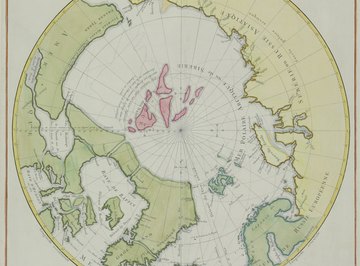

Early in the 20th century, science rejected the idea that the continents could change position. By the end of the century, geology had accepted the concept. Plate tectonics is the theory that the Earth's outer crust is a system of plates that moveconstantly. The continents move with them. Earth's magnetic poles played a part in proving the theory true.
Magnets and Rocks
Earth has a magnetic field extending between the north and south poles. The planet's rotation around its axis and the movement of liquid iron inside the Earth contribute to creating the magnetic field. When an iron-rich minerals such as magnetite becomes hot enough it loses their magnetic properties, but recovers them as they cool. During cooling the minerals become slightly magnetized, aligning with the direction of Earth's magnetic field.
Shifts and Changes
During the 1950s, geologists discovered that different layers of rock showed different magnetic orientations, ones that didn't align to the current magnetic field. One theory was that the magnetic poles moved over time. Polar-movement maps based on American rocks didn't match up with maps based on European and Asian geology, however. Researchers realized they could reconcile the maps if it was the rocks and the continents under them that moved. That added to the growing evidence in favor of plate tectonics.
Polar Flipping
The North and South Poles do change their position over time: the North Pole has been shifting further northward gradually, for instance. A bigger shift is that every 200,000 to 300,000 years, the poles flip their polarity, with the North Magnetic Pole adjusting the to the geographic South Pole. Geologists have found evidence for this in layers of ocean-floor sediment. Studying the sediment shows the magnetic orientation sometimes changes between different layers.
Flips and Tectonics
"Science News" reported in 2011 on a theory that plate tectonics affects the rate of polar flipping. Movement of molten iron inside the Earth seems to be the main driver in the flips, but the rate is influenced by how symmetrical the movements are in relation to the equator. Geophysical studies found that the more asymmetric the continents were, compared to the equator, the faster flips took place. There are multiple possible explanations how this works.
References
About the Author
A graduate of Oberlin College, Fraser Sherman began writing in 1981. Since then he's researched and written newspaper and magazine stories on city government, court cases, business, real estate and finance, the uses of new technologies and film history. Sherman has worked for more than a decade as a newspaper reporter, and his magazine articles have been published in "Newsweek," "Air & Space," "Backpacker" and "Boys' Life." Sherman is also the author of three film reference books, with a fourth currently under way.
Photo Credits
Hemera Technologies/AbleStock.com/Getty Images