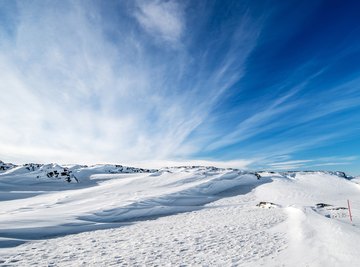

The environment in Antarctica and the Arctic Circle is one of intense cold, high winds and exceedingly low moisture. Despite the harsh conditions and temperatures recorded as low as -125.8 degrees Fahrenheit, plant life persists. Since most of Antarctica is covered in snow and ice, only 1 percent of the continent's landmass is suitable for the colonization of plants. The few plants that do manage to carve out an existence have a number of adaptations that allow them to contend with the extreme climate.
Frozen World of Polar Plants
The environment in the Arctic Circle and Antarctica prevents the typical plant growth seen on every other continent on earth. Vascular plants, such as ferns, trees and flowers, have been almost completely extricated from Antarctica since the period of glaciation began 50 million years ago. These plants are common in subantarctic regions, such as its nearby islands, but on the content of Antarctica itself, they are nonexistent. Instead, the predominant photosynthesizing life is made up of mosses, liverworts, lichens and photosynthesizing organisms, including algae and cyanobacteria.
Polar Roomates
Lichens make up 350 of the 800 species of Antarctic tundra plants. However, lichens are not technically plants; instead, lichens represent a symbiotic relationship between a fungi and algae or cyanobacteria. Lichens are especially adapted to the most forbidding environments on the planet, since they can shut down metabolically during periods of intense cold. In polar regions, favorable growing conditions only occur for very short periods. Lichens quickly begin photosynthesizing and growing when the opportunity presents itself, returning to dormancy as the long winter sets in. These lichens can grow less than a millimeter per year, and some may be among the oldest living organisms on earth.
Resilient Mosses
Mosses and liverworts are one of the primary photosynthesizing species in Antarctica, with over 130 distinct species. Known as bryophytes, these are true tundra plants -- they create all of their food from the sun and soil. Mosses are found everywhere lichens colonize, but liverworts have only been found in coastal regions. Fields of mosses can occur in areas rich in moisture, such as meltwater flushes or glacial flows.
Evolved for the Cold
Tundra plants in the coldest regions of the world have a number of adaptations that allow them to cope with the extreme climate. Most bryophytes are capable of reproducing asexually when traditional reproduction is inhibited by the cold. Additionally, these plants exhibit such traits as tightly packed stems and roots for water retention, since unfrozen water is extremely scarce. Most bryophytes growing in the Arctic and Antarctic regions live underneath a snow cover, which protects them from windblown ice and sand and the extreme cold. Without a snow cover, they're susceptible to a light-induced reduction in photosynthesis known as photoinhibition, which reduces their growth rates even further.
References
About the Author
Max Roman Dilthey is a science, health and culture writer currently pursuing a master's of sustainability science. Based in Massachusetts, he blogs about cycling at MaxTheCyclist.com.
Photo Credits
coolkengzz/iStock/Getty Images