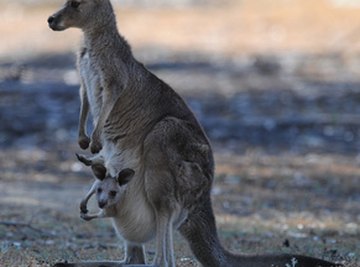
Pouched mammals belong to the 335 species of the infra-class Marsupialia. Found primarily in Central and South America and Australia, marsupial mammals are distinct from other mammals in that they give birth after a very short gestation period to tiny, immature young, which then must crawl to the pouch to nurse and continue growing. Because few marsupials have a placenta in which a fetus can develop fully, the pouch provides a protected environment for the maturation of the young.
American Opossums
There are 92 species of American opossums, most of which live in central and south America. Opossums are small, usually omnivorous foragers that have adapted to diverse environments, including grasslands, forests and areas of human habitation. American opossums usually give birth to large litters of young.
Bandicoots
The 21 species of bandicoots—small, rodent-like marsupials—live in Australia and New Guinea. Bandicoots are omnivorous and prefer a diet of insects. They have very short gestation cycles and produce several large litters of young each year.
Brushtail Possums and Cuscuses
Common throughout Australia and New Guinea, the 27 species of brushtail possums and cuscuses are adapted to nearly every Australian environment. These nocturnal mammals eat a diverse diet of leaves, seeds and insects.
Dasyurids
The dasyurids consist of seven species of large marsupial carnivores, including quolls and the Tasmanian devil. Found in coastal areas of Australia and New Guinea, dasyurids are fierce predators known for their occasionally aggressive behavior. Most dasyurids eat a diet of insects, although larger animals will hunt small mammals and birds, including livestock.
Kangaroos and Wallabies
Perhaps the most familiar of the pouched mammals, kangaroos and wallabies make up 76 species native to Australia and New Guinea. Kangaroos and wallabies prefer to travel by hopping on the hind limbs, and larger species can travel at over 35 miles per hour. The musky rat kangaroo may be less than a foot tall, while the red kangaroo can grow to over five feet.
Koalas
Not bears but marsupials, koalas are medium-size, tree-dwelling animals found in the eucalyptus forests of eastern Australia. They eat a limited diet of eucalyptus and other leaves. Because these leaves provide little nutrient content, the koala has a low-activity life.
Small Australian Possums, Ringtails and Gliders
There are 35 species of smaller Australian possums and gliders. Generally smaller than the brushtail possums and cuscuses, ringtails and gliders prefer to live in trees. The gliders have flaps of skin between their fore- and hind-limbs that allow them to glide from branch to branch.
Wombats
The three species of wombats are closely related to koalas. Found in southeastern Australia, wombats are herbivorous burrowers and grazers.
References
- University of Michigan Museum of Zoology Animal Diversity Web: Infraclass Metatheria
- "The Princeton Encyclopedia of Mammals"; David W. Macdonald (editor); 2006
About the Author
Heather Vidmar-McEwen has worked as a writer and editor for academic and nonprofit organizations since 2002. She has a master's degree in archaeology from Indiana University. Her articles specialize in culture, history, science, crafts and the natural world.
Photo Credits
Australian Kangaroo with Joey in pouch image by PoveyCam from Fotolia.com