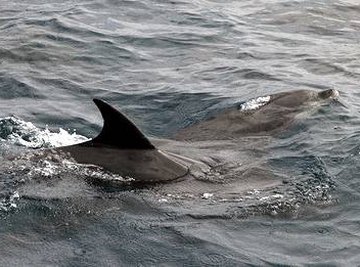

All dolphins are carnivores, eating fish and squid. Different species of dolphins focus on different foods and they have a variety of hunting styles. Some dolphins eat crustaceans such as lobsters, shrimp and crabs while some eat octopus and cuttlefish. Researchers are mystified about why dolphins sometimes kill their own calves and also porpoises in the Atlantic Ocean.
Function
Dolphins find food with their sense of sight and more importantly, with their sense of hearing. Dolphins can emit sound waves that return an echo vibration from their prey, an ability called echolocation. Echolocation provides information such as the object's size, shape, speed and which direction it is going. This information cannot always be obtained with vision in the dark waters of the deep ocean. In addition, the dolphin's auditory nerve, the mechanism connecting the inner ear to the brain stem, is about twice as wide as a human's auditory nerve. This results in speedier processing of sounds, essential in the dolphin's search for moving fish. Sound also travels further in water than in air and over four times faster as well, which assists dolphins in their skill as hunters.
Identification
There are 32 species of dolphins, of which the bottlenose is the most recognized. Dolphins are part of the mammalian order cetaceans, which also includes whales and porpoises. Different species have particular hunting styles and a variety of diets. Dolphins with long snouts and many teeth mainly target fish, while dolphins with short snouts and fewer teeth are more likely to go after invertebrates. Although some dolphins have a large number of teeth, they still typically swallow fish whole.
Types
Types of hunting include pods of dolphins herding a school of fish for easier pickings, foraging in the sea bed or emitting very loud clicks at fish that essentially stuns them with a sonar wave. Sometimes, dolphins chase fish to shallow water or even up onto banks for easy capture. A dolphin can stun or kill a large fish by hitting it with its tail.
Considerations
Researchers studying dolphins off the coast of Scotland have been trying to figure out why dolphins have been killing porpoises there for at least the past 20 years. Typically, dolphins and porpoises do not eat the same types of fish, but scientists think that food rivalry might be a reason. Scientists also have theorized that maybe the porpoises were viewed as threatening to juvenile dolphins.
Theories/Speculation
Some researchers also have witnessed adult bottlenose dolphins killing baby dolphins. The scientists have speculated that male dolphins may be destroying the offspring of rivals, in order to create more mating opportunities. Females that are tending calves stay sexually inactive for several years and so are unavailable to mate. Although infanticide is common in nature, this has apparently been the first evidence of the behavior among cetaceans. A group of researchers from universities in Virginia and North Carolina are also studying instances of dolphin infanticide along the United States Atlantic coast. Researches think it is significant that the dolphin calves and the porpoises are about the same size.
Resources
About the Author
Shelley Moore is a journalist and award-winning short-story writer. She specializes in writing about personal development, health, careers and personal finance. Moore has been published in "Family Circle" magazine and the "Milwaukee Sentinel" newspaper, along with numerous other national and regional magazines, daily and weekly newspapers and corporate publications. She has a Bachelor of Science in psychology.
Photo Credits
http://www.flickr.com/photos/hjallig/558708393/