Clouds can seem like a very abstract part of nature. Authors even use imagery of a mass of dark billowing clouds on the horizon to represent some unforeseen threat looming just out of human perception. In reality, the presence of clouds is a much more scientific phenomenon.
There are three main types of clouds: cirrus, cumulus and stratus. They are made when air rises because of heat, the shape of the landscape or a weather front and is cooled as it reaches higher altitudes. Cumulus clouds are made of different states of water and air.
Cumulus Definition
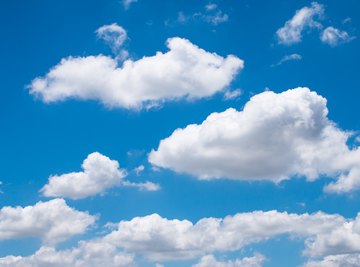
All clouds have a distinctive look and shape to them, which is how we define them. The cumulus definition for cumulus clouds is clouds that have a flat based along with "fluffy" or "cotton candy-like" structures.
The cumulus definition is rooted in the Latin word "cumulo" that translates to "pile" or "heap". This makes sense seeing as cumulus clouds look like heaps of fluff.
Thermals
Cumulus clouds look fluffy to the naked eye because of air bubbles called thermals. These pockets of air linger in the clouds and give them their pillow-like appearance.
As the air of the thermal rises, the thermal starts to shed layers and become smaller. This continues until it is gone.
Water Vapor
Water vapor is the first physical state of the H2O molecule as it cycles through the cumulus cloud. When a water molecule is in a vapor state, it is light enough to rise into the atmosphere on warm air currents. Three main factors precipitate the initial rise of these water vapor particles.
The first, a process known as convection, is when cold air sinks and warm air rises; the cycle lifts water vapor into the air. The second is when the topography of the Earth that the air containing the water vapor moves over increases in altitude; the water vapor can be forced up higher into the atmosphere.
The third is when a cooler air mass meets a warmer one -- the warmer air is forced up into the atmosphere along with the water vapor it is carrying.
Water Droplets
Warmer air is able to hold more water vapor molecules than cooler air. As the water vapor reaches cooler air, it reaches the saturation point. At the saturation point, the temperature is reached where the water vapor changes into visible water droplets.
This visible water molecule is a type of condensation that takes place in the atmosphere. When the water reaches this visible stage, the cloud begins to become visible to the naked eye. If water droplets combine, they can get too heavy to stay aloft in the atmosphere. This is when rain and other precipitation is formed.
There's actually a particular type of cumulus cloud that yields rain: a cumulonimbus cloud. Cumulonimbus clouds' definition also comes from its latin roots. "Cumulo-" meaning heap or pile refers to the cumulus nature of the cloud. "Nimbus" translates to rainstorm.
So a cumulonimbus clouds definition literally means cumulus rainstorm clouds. They're often larger and form towering shapes in the sky. They can also appear darker than cumulus clouds.
Ice Crystals
Ice crystals are the form the H2O molecule takes when water vapor is turned into clouds in air that is below 0° C or 32° F. These form alongside water droplets that are very close to 0° C but that do not cross the threshold point.
As the ice crystals move through the cloud, they pick up more water vapor, which solidifies with the ice crystal to create a larger ice crystal. As the ice crystal gets heavier, it starts to fall and combine with other ice crystals.
Eventually, like the water droplets, the ice crystals become too heavy to float in the atmosphere and they drop toward the ground. If the air continues to be cold enough all the way to the ground, the ice crystals fall to the ground as snow; otherwise they melt and fall to the ground as rain.
References
Resources
- "The Cloudspotter's Guide: The Science, History, and Culture of Clouds"; Gavin Pretor-Pinney; 2006
About the Author
Emily Holland is a student writer earning a degree in international relations with a minor in Spanish from North Carolina State University. She began writing professionally in 2011, specializing in travel, education, literature and cultural issues. Holland has a certificate in Global Perspective and studied in València, Spain and Antiqua, Guatemala.