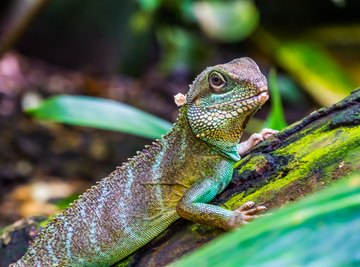

Although they are both ectotherms, may look similar, and many share similar diets, newts and lizards are very different animals. Newts and lizards can be found across the globe in a variety of habitats. Newts and lizards are both vulnerable to habitat destruction, pollution and the illegal wildlife trade. Unfortunately, due to these factors, many species are now endangered.
Newt Vs. Lizard
Like all vertebrate animals, newts and lizards fit under the phylum Chordata. As chordates, both newts and lizards have a notochord, nerve cord and pharyngeal slits during embryonic development. However, this is where their taxonomy branches off, and the differences begin.
Newts (Salamandridae) are members of the Amphibia class along with frogs (Anura) and caecilians (Gymnophiona) while lizards (Squamata) are in the Reptilia class with tuatara (Sphenodontia), snakes (Squamata), turtles (Testudinata) and crocodiles (Crocodilia). Amphibia is derived from the Greek word amphibios, which means "living a double life." Amphibians generally have both aquatic and terrestrial life stages. Reptiles differ from amphibians in that they have scales and internal fertilization.
What Is a Newt?
There are over 50 species of newts in the Salamandridae family. Salamanders and newts are a type of amphibian with a tail. Amphibians have dry skin that they must keep moist to breathe. Due to this most amphibians, including newts, live in wetland habitats, shady forest floors, damp caves, near ponds, lakes and rivers. Newts tend to have bright patterns of their skin, advertising their toxicity.
Newt Reproduction
Newt reproduction varies significantly between species. Many species of newt return to the water to breed, although others breed lay their eggs on land. Newts also typically fertilize the eggs externally after courtship.
Depending on the species newts can lay up to 450 eggs at any one time. The eggs are covered in a toxic jelly-like coating for protection. The mother newt will curl around her eggs or cover them with leaves to protect her baby newts further. Once the eggs hatch, they live in a larval stage before undergoing metamorphosis into their adult form.
Newt Diet
Newts typically grow between 4 to 6 inches (10 to 15 cm) long. The great crested newt (Triturus cristatus) is Europe's most giant newt, reaching 7 inches (17.78 cm). Due to their slow-moving nature, they tend to target slow-moving invertebrate prey like earthworms, slugs and snails. Large newt species also eat small animals such as fish, crayfish, mice and shrews.
Newt Vs. Salamander
Salamanders can be separated into two groups, newt and "true salamander." People typically describe true salamanders as living a highly aquatic existence and newts as more terrestrial animals, although most still have an aquatic life stage. A clear difference between them is that newt's skin is usually rough and wrinkled while salamander's skin is smooth.
What Is a Lizard?
There are over 4,675 described lizards species. Unlike their close relative, snakes, lizards usually have four legs, moveable eyelids and external ear openings. Lizards come in a wide range of sizes, colors and shapes. Geckos (Gekkota), skinks (Scincidae), chameleons (Chamaeleonidae), iguanas (Iguanidae) and monitors (Varanidae) are all types of lizards.
The largest extant lizard is the Komodo dragon (Varanus komodoensis), which lives in the Komodo islands of Indonesia. The Komodo dragon can grow up to 10 feet long (3 meters) and weigh up to 300 pounds (135 kilograms). The current world title for world's smallest lizard goes to a group of Malagasy leaf chameleons (Brookesia minima spp.) found in northern Madagascar. These tiny chameleons reach a maximum length of just over 1 inch (30 millimeters) and weigh around 0.007 ounces (0.2 grams).
Lizard Reproduction
Typically lizards mate via internal reproduction and then lay eggs; however, in some species, the mother keeps her eggs inside during their development. While most lizards lay their eggs and leave them, some females guard their eggs against predators.
For example, Komodo dragons dig holes in the ground, on hillsides or make large mounds to bury her eggs. For three months, she guards the nest, then leaves before her eggs are ready to hatch. Komodos sometimes make decoy nest chambers to distract predators, including other Komodo dragons, from the real nest.
Lizard Diet
Lizards can be found in every continent except for Antarctica. The diet of each species varies depending on their adaptations to their environment. Some species are solely herbivorous; others are insectivores, omnivores or carnivores.
Different dietary requirements require different methods of sourcing food. For example, chameleons are well known for their long, sticky tongue that they can shoot out of their mouths at high speeds to capture their prey. Some reptiles, such as the Mexican beaded lizard (Heloderma horridum) and Gila monster (Heloderma suspectum), have venom in their saliva and poison their prey by biting them. The herbivorous marine iguanas (Amblyrhynchus cristatus) in the Galapagos Islands take a different tact and are adapted to diving into the ocean to eat seaweeds during high tide.
Pets and Wildlife
The illegal wildlife trade for amphibians and reptiles is a huge problem worldwide. Before deciding to keep a pet of any kind one must heavily research the species demands and source animals from a reputable breeder as many breeders still source wild animals. Even though these critters are not the most active creatures, keeping a pet newt or lizard is a big responsibility. They require a large enclosure and very particular environments to keep them happy and healthy.
References
- TRAFFIC: Reptiles and Amphibians
- Saint Louis Zoo: Amphibians
- Encyclopaedia Britannica: Caudata
- Encyclopaedia Britannica: Newts
- San Diego Zoo: Salamanders and Newts
- National Geographic: Great Crested Newt
- Tree of Life: Chordata
- Encyclopaedia Britannica: Amphibians
- Encyclopaedia Britannica: Reptile
- Encylopaedia Britannica: Lizard
- Encyclopaedia Britannica: Komodo Dragon
- San Diego Zoo: Lizard
- San Diego Zoo: Komodo Dragon
- PLOS ONE: Discovery of Miniaturized and Microendemic New Species of Leaf Chameleons (Brookesia) from Northern Madagascar
- University of Michigan: Amblyrhynchus cristatus
About the Author
Adrianne Elizabeth is a freelance writer and editor. She has a Bachelor of Science in Ecology and Biodiversity, and Marine Biology from Victoria University of Wellington in New Zealand. Driven by her love and fascination with all animals behavior and care, she also gained a Certificate in Captive Wild Animal Management from UNITEC in Auckland, New Zealand, with work experience at Wellington Zoo. Before becoming a freelance writer, Adrianne worked for many years as a Marine Aquaculture Research Technician with Plant & Food Research in New Zealand. Now Adrianne's freelance writing career focuses on helping people achieve happier, healthier lives by using scientifically proven health and wellness techniques. Adrianne is also focused on helping people better understand ecosystem functions, their importance, and how we can each help to look after them.