
The mesquite tree is one of the most common trees of the southwestern United States and parts of Mexico. It is a member of the legume family of plants which includes peanuts, alfalfa, clover, and beans. Perfectly adapted for its dry environment, the mesquite is a hardy tree. Here is the lowdown on the mesquite tree.
Geography
The mesquite grows in the northern parts of Mexico including the Chihuahuan Desert, which is a mountainous desert region that is on the US-Mexico border. The mesquite thrives from its Mexican range all the way through Texas and up into the southwestern portions of Kansas. It extends from the Sonoran Desert in southern California to southwestern Utah. Most of the places that you will find mesquite trees in have a low annual rainfall.
Types
There are three types of mesquite tree that grow in this region. One is the honey mesquite, another is the screwbean mesquite, and finally there is the velvet mesquite. The honey mesquite gets its name from its fragrant flowers. The screwbean mesquite is so named because it has screw-like pods. The velvet mesquite has leaflets which feel velvety to the touch.
Size
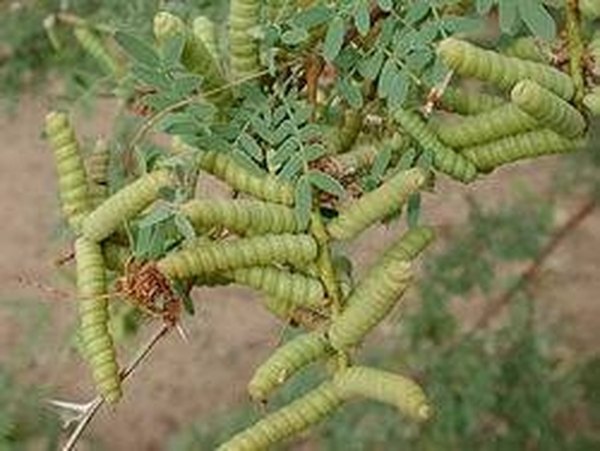
The honey mesquite can grow to 20 feet in height with a trunk that is a foot in diameter. Like the other mesquite species it has spines; they are 3 inches long and occur along the branches. The narrow leaves are pointed and are 2 to 3 inches long. The screwbean also can get as large as 20 feet. It has a 2-inch fruit that develops from its flowers that resembles the spiraling shape of a screw. The velvet mesquite is bigger than the other two, with a diameter that can reach 2 feet and growing to an average of 30 feet. It has 4-inch long spikes and an 8-inch fruit, like the honey mesquite does.
Features
Mesquite trees have a long taproot that they use to locate enough moisture to keep them alive. This feature allows them to survive through droughts. There are recorded instances of taproots of the mesquite tree reaching a depth of almost 200 feet down into the soil. The roots of the mesquite can regenerate if the tree is chopped off above, making the mesquite one tough tree to get rid of. Ranchers feel that the mesquite sucks water from the land that could be used for livestock and farming, making it unpopular with those individuals.
Benefits
The benefits of the mesquite tree far outweigh any perceived shortcomings. The wood is very hard and it is used in making furniture and tool handles. The flowers from the mesquite species provide bees with nectar to produce honey. They grow rapidly and are a shade source for animals. The bean pods they produce can be turned into flour and used for baking. Animals can eat the fruit; coyotes survive almost exclusively on mesquite pods during the winter months. Mesquite wood used for firewood burns slowly and generates great heat; it is used to barbecue food in the southwest and lends a distinct flavor to whatever is cooked over it.
About the Author
John Lindell has written articles for "The Greyhound Review" and various other online publications. A Connecticut native, his work specializes in sports, fishing and nature. Lindell worked in greyhound racing for 25 years.
Photo Credits
www.nps.gov