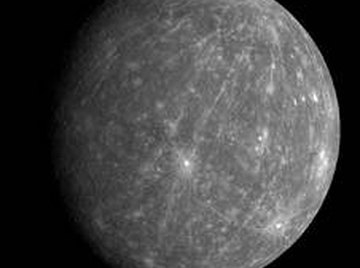
In the solar system, a year is determined by how long it takes for a planet to revolve around the sun, and a day is determined by how long it takes for a planet to completely rotate on its axis. Mercury has an unusual length of day when compared to most of the other planets in the solar system.
Time Frame
Mercury rotates on its axis very slowly, while it orbits the sun quickly. In fact, one day is actually as long as two years on Mercury. It takes Mercury about 88 Earth days to orbit the sun, while Earth takes 365 days. It takes about 176 Earth days for Mercury to rotate on its axis (from sunrise to sunrise), while Earth takes only 24 hours. On Mercury, it is daytime for one year, and night for one year.
Considerations
Venus, the planet between Earth and Mercury, also has a day that is longer than its year. Venus has the longest day of any planet in our solar system. One day on Venus lasts for 243 Earth days, while a year lasts about 225 Earth days.
Features
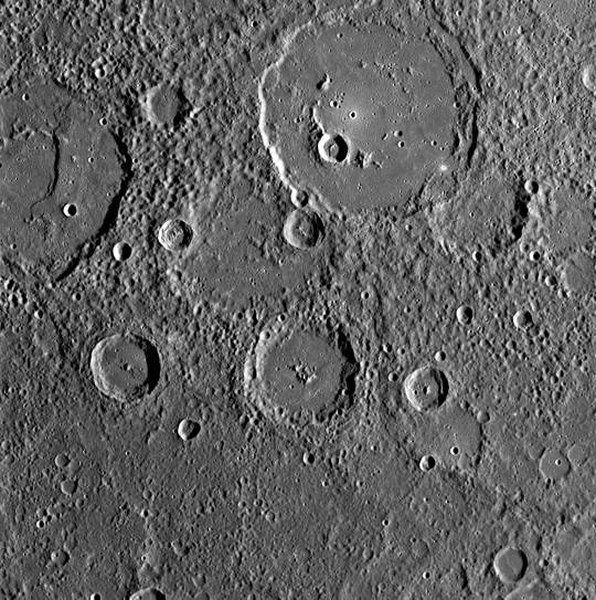
Because Mercury has an elliptical orbit around the sun--compared with Earth's circular orbit--and because it has such a slow rotation, this makes the sun appear to move in a way that people from Earth would find highly unusual. Sometimes the sun comes to a complete stop, then seems to move backward for a while, then moves forward again in a loop back to the position where it had stopped at previously, before moving forward. The sun also sometimes looks larger and sometimes smaller, and decreases in size to the point where background stars can be seen. Sometimes the background stars appear to be moving three times faster than the sun. Mercury has a very thin atmosphere and looks a lot like Earth's moon.
Geography
Mercury is the closest planet to the sun, about 58 million kilometers away. Earth is about 150 million kilometers from the sun. Because of its proximity to the sun, here on Earth we can only see Mercury with the naked eye or with binoculars when it appears as a bright star close to the horizon just after sunset or just before sunrise.
Identification
Mercury is either the smallest planet, or the second smallest if Pluto is counted as a planet. Since Pluto was re-categorized as a dwarf planet in 2006, debate continues about whether Pluto still actually should be considered a planet or rather an asteroid body. Mercury's diameter is 4,879 kilometers, which is not much larger than Earth's moon at 3,475 kilometers. Both are larger than Pluto, with a diameter of 2,390 kilometers.
About the Author
Shelley Moore is a journalist and award-winning short-story writer. She specializes in writing about personal development, health, careers and personal finance. Moore has been published in "Family Circle" magazine and the "Milwaukee Sentinel" newspaper, along with numerous other national and regional magazines, daily and weekly newspapers and corporate publications. She has a Bachelor of Science in psychology.
Photo Credits
Photo by NASA/Johns Hopkins University Applied Physics Laboratory/Carnegie Institution of Washington