
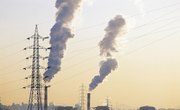
A footprint is a mark you leave by walking. The way you live also leaves a mark. Many things we do in life, such as producing energy, driving cars and raising livestock, generate gases that contribute to climate change. And almost all of these gases are carbon compounds. That’s why the effect your life has on climate change is called your carbon footprint. Sometimes the way we affect climate change is obvious, such as driving cars. Sometimes it's not so obvious, such as eating meat.
Greenhouse Effect
Unless something stops it, radiant heat leaving Earth heads out to space. That’s why cloudless nights tend to be cooler. In a greenhouse, the clear glass or plastic doesn’t let radiant heat escape. It absorbs it and sends a portion of it back inside. Gasses in the atmosphere such as carbon dioxide (CO2), methane and chlorofluorocarbons (CFCs) do the same thing on a global scale. These gases are made of carbon.
Greenhouse Gas by Sector
Estimates vary for how much greenhouse gas is emitted by different sectors of activity. The numbers can also be difficult to understand because of different ways sectors are defined. Statistics compiled by Ecofys and ASN Bank in 2010 are: industry (29 percent), residential buildings (11 percent), commercial buildings (7 percent), transportation (15 percent), agriculture (7 percent), energy supply (13 percent), land use change such as deforestation (15 percent) and waste (3 percent).
Industry
Many industrial processes require a lot of energy. Much of the industrial greenhouse gas emission comes from the mining and refining of minerals and metal ores. Another major contributor is chemical processes used in manufacturing. It also includes burning fossil fuels onsite to produce energy used at the mine or plant. Many of the things we use are produced by industry. Reducing, reusing and recycling help us leave smaller carbon footprints.
Residential Buildings
A full 50 percent of residential greenhouse gas emissions comes from energy used for heating and cooling our living spaces, and heating water for baths and showers. Another 11 percent is from lighting. Many people set their thermostats in ways that save money and energy. Incandescent light bulbs are being phased out in many parts of the world, including the U.S., in favor of energy efficient and longer lasting fluorescent bulbs and LED lights. The U.S. Environmental Protection Agency has created the Energy Star program that labels energy efficient appliances to help consumers make energy saving choices.
Transportation
Almost all cars burn fossil fuels such as gas or diesel fuel. Even the electricity for electric cars must come from somewhere. Just making cars uses a lot of energy. Transportation choices such as buying fuel efficient cars, taking public transportation, walking or biking lessen our impact.
Agriculture
Many people are not aware that a huge portion of methane, a more powerful greenhouse gas than CO2, is generated by agriculture. Much of this comes from livestock. For production purposes, livestock are fed foods to help them grow quickly, but that they don’t digest well. The food ferments in the animals’ guts, producing methane that comes out.
Energy Production
To have coal, oil or gas to produce electricity at generating stations, you need to mine or extract it first. Then you need to transport it. Gas-guzzling machinery is often used, and natural gas escapes. In other words, a lot of greenhouse gas is produced that doesn’t even get used to generate electricity or power cars.
References
- United States Environmental Protection Agency: Causes of Climate Change
- U.S. Environmental Protection Agency: Global Greenhouse Gas Emissions Data
- What’s Your Impact: What Are The Main Sources of Greenhouse Gas Emissions?
- U.S. Environmental Protection Agency: Energy Star
- Center for Climate and Energy Solutions: Residential and Commercial Emissions in the United States
About the Author
Ariel Balter started out writing, editing and typesetting, changed gears for a stint in the building trades, then returned to school and earned a PhD in physics. Since that time, Balter has been a professional scientist and teacher. He has a vast area of expertise including cooking, organic gardening, green living, green building trades and many areas of science and technology.
Photo Credits
Mike Powell/Digital Vision/Getty Images