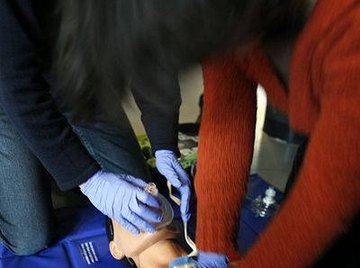

CPR is an acronym that stands for cardiopulmonary resuscitation. CPR is an emergency procedure in which a medical professional or Good Samaritan gets the heart and lungs of a victim working again by compressing the chest by hand and forcing air into the lungs.
TL;DR (Too Long; Didn't Read)
CPR stands for cardiopulmonary resuscitation.
History
CPR has been a medical abbreviation and procedure for the past 50 years. It uses artificial respiration along with chest compressions to return a heart beat and/or breathing to victims of heart attacks or respiratory arrest. But earlier this year, the American Heart Association announced that it endorses the use of chest compressions alone--without artificial respiration--for adults who collapse suddenly in cardiac arrest.
Significance
CPR is an important way to keep a victim's organs alive immediately after a heart attack or another event, such as drowning, that can cause a person to stop breathing. During such an event, a victim's blood will stop circulating, and oxygen will not get to organs, particularly the brain. CPR provides oxygenated blood to the organs until help arrives. The brain can be damaged by a lack of oxygen in as little as four minutes, and can suffer irreversible damage after about seven minutes. For that reason, CPR is usually effective only if it's performed within seven minutes, and as quickly as possible, after a heart attack. Victims who are not breathing, as in the case of drownings, are often administered CPR that includes artificial respiration to assist in the breathing process.
Misconceptions
It's a common misconception that CPR is successful. In fact, only 5 to 10 percent of victims who receive CPR alone survive, and many victims who do survive develop complications. Most medical experts and organizations emphasize that CPR does not bring a person back from an event like a heart attack, but helps to delay death and preserve the body long enough for advanced life support. It's important to remember that the combination of immediate CPR followed by advanced life care, such as defibrillation, does improve a victim's chances of survival. A victim has a 40 percent chance of survival if two things happen: CPR is started within 4 minutes of collapse and defibrillation is provided within 10 minutes.
Prevention/Solution
The best way to learn more about CPR is to take a class. This way, you can become a knowledgeable caregiver in case you're ever confronted with the opportunity to help save someone's life. CPR classes are routinely available in most parts of the country and can be found by going to the American Red Cross website and looking for classes in your community. The Red Cross provides first aid, CPR and Automated External Defibrillator programs designed to give civilians the knowledge they might need to respond in an emergency situations.The classes are available for just about any age group and can be tailored for adults who work with children, employee groups, and professionals.
Types
Generally, two types of CPR are performed on victims and differ based on the cause of a victim's collapse. The American Heart Association changed its definition of CPR earlier this year, so it's important to know that on adults who have apparently suffered a sudden heart attack, experts now say chest compressions -- about 100 a minute -- are enough to keep a victim alive until help arrives. Adults who have suffered a heart attack collapse, stop breathing and are unresponsive, but still have enough air in their lungs that they don't need artificial respiration performed. Mouth-to-mouth breathing should be administered, say experts, if the victim is a child who's collapsed or an adult who has lost oxygen because of a near-drowning, carbon monoxide poisoning or a drug overdose. These victims still need to get air into their bloodstream and lungs.
About the Author
Evelyn McCormack is a former New York daily newspaper editor and writer with more than 35 years of experience writing about travel, New York City and social media. She also speaks frequently at regional and national conferences about using social media as a news and public-relations tool. McCormack holds a Bachelor of Arts in journalism from the University of Rhode Island.