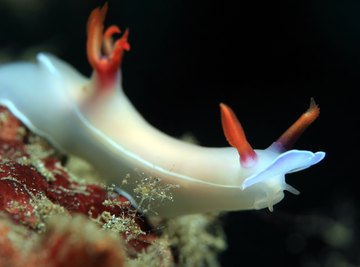
Platyhelminthes are simple organisms made up of only three cell layers. They are bilaterally symmetrical. Platyhelminthes are known commonly as flatworms. According to W. D. Dolphin at Iowa State University, the Phylum Platyhelminthes includes planaria, which are free-living organisms, and parasitic flukes and tapeworms.
Anatomy
Some flatworms have one body opening that is used to take in food, expel waste and release fertilized eggs. Others have a tubular system with a mouth and anus. Many flatworms produce both male and female reproductive cells and can fertilize their own eggs. Respiration takes place on a cellular level by direct diffusion--cells take in oxygen and release waste products directly from and to the environment.
Planaria Life Cycle
Planaria live independently in water. They are found in both saltwater and freshwater environments. They are hermaphrodytic, meaning they can produce both ova and sperm. Both kinds of reproductive cells are released into the central body cavity. The fertilized ova are released into the environment along with waste materials. The eggs hatch into miniature versions of their parents.
Animal Parasites
Some platyhelminthes are parasitic. They live part or all of their lives dependent upon another living organism. As described in an article from Bellarmine University, the Chinese liver fluke begins life as a microscopic egg floating in water.The egg is eaten by a snail. When it hatches, it is called a miracidium. It lives as a parasite inside the host snail, burrowing into its gut and forming a sporocyst. The sporocyst develops many chambers. Inside each chamber, a redia develops through asexual reproduction. Each redia then forms chambers and again reproduces asexually. Each chamber produces many free-swimming cercaria. The cercaria leave their snail host and find a second animal host. This time, they burrow into the skin of fish. Once inside the fish, they form encapsulated cysts called metacercaria.
Human Parasites
When an infested fish is caught and undercooked or consumed raw, the metacercaria are released from their cysts by the digestive juices of a human host. They travel through the digestive system through the bile duct of their human host to the liver, where they feed on their host's blood and grow into adult flukes. The adult flukes lay eggs that are excreted in the host's feces. In areas where plumbing is non-existent, the local water supplies may be tainted with many such potential parasites. According to Bellarmine University, in some parts of China the rate of human liver fluke parasitism is close to 100 percent.
Tapeworm Reproduction
Tapeworms are flatworms that are segmented. Each segment, or proglottid, is capable of producing fertilized eggs. According to information from the University of Colorado, some species shed eggs inside their hosts continuously, and others wait until a segment is full of eggs and then release the entire segment, which then opens to disperse the eggs. The eggs are excreted in the feces of the host animal or person. Often there is an intermediate host where the larval form develops and is passed to the primary host through consumption of infested meat.
Resources
About the Author
Rose Guastella is a professional artist and teacher from Kitsap County, Wash. She has been writing educational materials for schools since before 1990. Guastella holds a Master of Arts in liberal studies from the State University of New York at Stony Brook. She has contributed several articles about education and plant biology to various websites.