Many parts of the California coastline offer shelter to a variety of wildlife and plant species. The U.S. and California state governments protect most of California's coastal region to ensure the survival of these species. Tourists do have access to these recreation areas, though. California's coast has parkways and hiking trails that offer tourists opportunities to see this region's animals and plants. Read on to learn more about California coast plants and animals.
Blue and Humpback Whales
You can often see blue whales from the California coastline as they migrate from Alaska to Baja every year. They're the largest animals in the world. These marine mammals grow up to 108 feet in length when they mature, which is about as long as three school buses. Their weight can also reach more than 300,000 pounds. Blue whales are endangered. The scientific name for blue whales is Balaenoptera musculus.
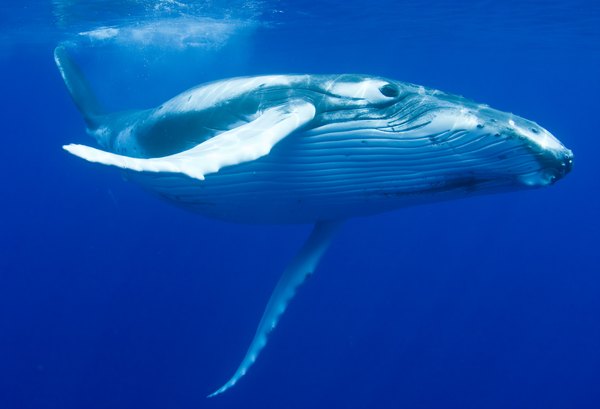
During the summer and fall, humpback whales migrate past the California coast. Humpback whales, or Megaptera novaeangliae, are dark-skinned mammals and grow up to 55 feet in length. These whales can be identified by the hump on their backside. Humpback whales often have friendly encounters with boats.
The Marine Plants
California has two species of eelgrass in its saltwater areas: Pacific eelgrass, or Zostera marina, and dwarf eelgrass, or Zostera japonica. These slender marine grasses are primarily found in sheltered bays and estuaries. The Pacific eelgrass is native to California, but dwarf eelgrass is originally from Asia. The latter of the two has become an invasive species.
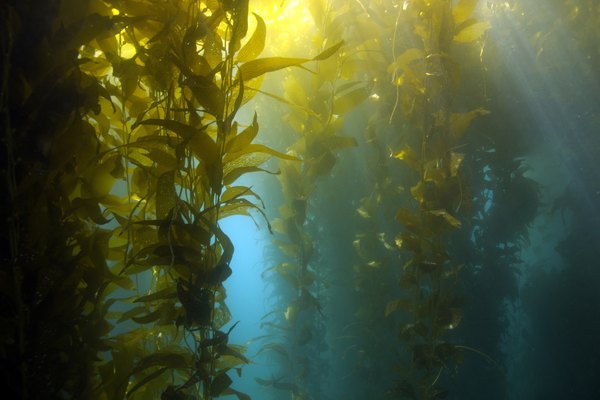
Giant kelp, or Macrocystis pyrifera, is found near the shores of Northern, Central and Southern California. This species of marine plant grows as long as 200 feet when it matures. Needing warmer temperature, giant kelp usually doesn't stray further than 120 feet from the mainland.
The Coastline Animals
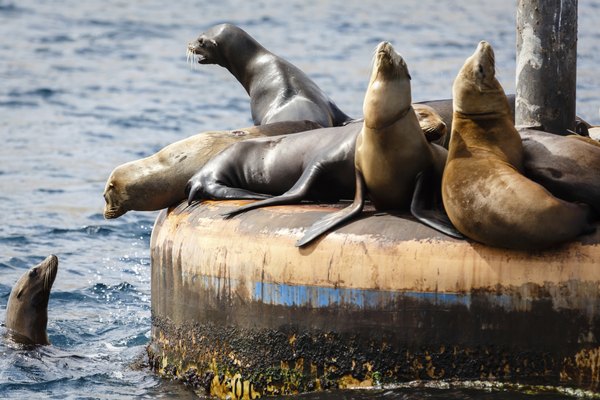
Northern elephant seals, or Mirounga angustirostris, spend most of the year in the depths of the Pacific Ocean. However, these mammals dwell on the coast of Central California during December through March, which is the mating, molting and birthing season. Male elephant seals grow to 14 feet. Before molting, elephant seals have blackened skins, but molting reveals their flesh to have a silver coloration.
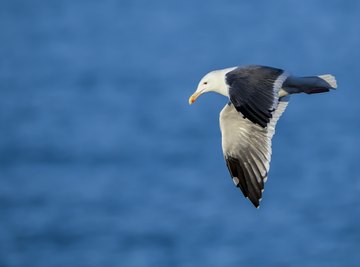
The California gull, or Larus californicus, is a medium-sized gull bird with an average length of 17 inches and wingspan of 52 inches. This bird frequents the Californian coastline during the winter, but the San Francisco Bay Area is the only region where coastal nesting occurs. California gulls are nonviolent in the presence of humans, but prey on small mammals and invertebrates.
The Coastal Flowers

Beach morning glories, or Ipomoea pescaprae, are found on beaches throughout California, including Southern California's Silver Strand State Beach. These beach flowers have pinkish and white petals and their leaves have a fleshy texture. Late spring and early summer is the blossoming period for beach morning glories.
The Central and Southern Californian coastline features yellow bush lupines or a flowering shrub with yellow petals. This shrub grows up to 6 feet in height. Yellow bush lupines are also in Northern California, but are an invasive species in that region.
References
About the Author
Skip Davis has been writing professionally since 2005. His work has appeared in "Southern Literary Magazine," on various websites and in graphic panels at the Jackson Zoological Park in Jackson, Miss. Currently living in Southern California, Davis received his Bachelor of Arts in theater at Belhaven College.