Thermonuclear bombs, better known as hydrogen bombs, are the single most destructive weapon ever created by the human race. Powered by a combination of nuclear fission and nuclear fusion – the same process the sun uses to generate energy – these bombs have the capacity to unleash incredible amounts of destruction. Tsar Bomba, the largest bomb ever tested, was a hydrogen bomb that caused severe destruction within a roughly 60-mile (100 km) radius. In comparison, the nuclear bomb dropped on Nagasaki, Japan, caused destruction within a radius of roughly 5 miles (8 km). Only five countries have been confirmed to have built hydrogen bombs: the United States, Russia, France, China and the United Kingdom, but recent claims by North Korea suggest that a sixth country may be on the list. International political tension begs the question: What does a hydrogen bomb do?
TL;DR (Too Long; Didn't Read)
Hydrogen bombs function like nuclear bombs, like those dropped during World War II, only on a much larger scale. Few hydrogen bombs have been tested, and long-term effects are still under investigation – but evidence found at hydrogen bomb test sites at Bikini Atoll and Novaya Zemlya suggest that environmental after-effects can last for decades.
Atomic Bombs vs. Hydrogen Bombs
All nuclear weapons rely on the process of nuclear fission, in which an atom or nucleus is broken apart into two pieces, releasing incredible amounts of energy. The core difference between atomic bombs and hydrogen bombs specifically is that the latter use a combination of nuclear fission and nuclear fusion – where two atoms are forcibly fused together at high temperatures and pressures – to produce an exponentially larger explosion. Hydrogen bombs as they exist today are multistage explosives: They actually use atomic fission bombs as the trigger to induce fusion, so they're essentially two bombs built on top of each other. Hydrogen bombs are a subclass of atomic bombs for this reason.
Initial Blast Effects
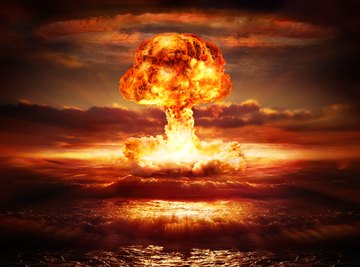
When a hydrogen bomb is detonated, the immediate effects are devastating: Looking in the general direction of the blast can cause temporary or permanent blindness, and the area at the center of the explosion is essentially vaporized. As the ground shatters, dirt and sand are fused into glass, and a massive fireball creates the iconic “mushroom cloud” associated with nuclear weapons. The force of the explosion also creates a concussive blast that rips trees from the ground, shatters glass, and can destroy brick and concrete buildings miles away from the blast center.
Radiation and Fallout
After the initial blast, the explosion of a hydrogen bomb would send radioactive particles into the air and create smoke that could hinder plant life that depends on sunlight to survive. The radioactive particles would spread and settle over a period of minutes or hours, potentially carried for hundreds of miles by wind – contaminating the air, land and potentially water with substances capable of damaging cells in plants, animals, fish and humans. This could create hazardous changes to genes and cause mutations that could do harm for generations. Similar conditions have been observed in the area around the site of the Chernobyl nuclear disaster. At the same time, if nuclear contaminants reach water, fish and other marine life populations could suffer harm or pass contaminants up the food chain.
Long-Term Mysteries
Many of the long-term effects of a hydrogen bomb explosion are unknown or still being discovered, as research on the sites of many hydrogen bomb test sites are lacking. It is known, however, that nuclear contamination from hydrogen bombs can persist and adversely affect populations for upwards of 40 years: 60 years after U.S. tests on Bikini Atoll, populations who lived on the islands for generations are still unable to resettle for fear of sickness and irradiated soil giving way to toxic crops. Around Novaya Zemlya, where the Tsar Bomba was tested, there are fears that nuclear fallout may have adversely affected fish populations accessed by Norway and Canada. Research into the after-effects is ongoing, but slow.
References
- The Nuclear Weapon Archive: Big Ivan, The Tsar Bomba (“King of Bombs”)
- The Nuclear Weapon Archive: Complete List of All U.S. Nuclear Weapons
- The Atlantic: What Would a Hydrogen Bomb Do to the Pacific Ocean?
- The Guardian: Bikini Atoll Nuclear Test: 60 Years Later and Islands Still Unliveable
- Encyclopedia Britannica: Thermonuclear Bomb
- TIME: What Is the Difference Between a Hydrogen Bomb and an Atomic Bomb?
- Business Insider: There's a Major Difference Between a Hydrogen Bomb and an Atomic Bomb
- National Academies Press: Human and Environmental Effects
- Greenfacts: How Has the Environment Been Affected by the Chernobyl Accident?
- CTBTO: Effects of Nuclear Testing by the Soviet Union
- The Nuclear Chain: Novaya Zemlya, Russia
- Atomic Archives: The Atomic Bombings of Hiroshima and Nagasaki
About the Author
Blake Flournoy is a writer, reporter, and researcher based out of Baltimore, MD. Working independently and alongside professors at Goucher College, they have produced and taught a number of educational programs and workshops for high school and college students in the Baltimore area, finding new ways to connect students to biology, psychology, and statistics. They have never seen Seinfeld and are deathly scared of wasps.