About Rutherford's Gold Foil Experiment

About Rutherford's Gold Foil Experiment thumbnail
Rutherford's discovery led to knowledge of the nucleus.

New Zealand scientist Ernest Rutherford is credited as being the father of nuclear physics for his discoveries in atomic structure. Rutherford first proposed the theory of the nucleus as it is known today. His "gold foil experiment" led to the discovery that most of an atom's mass is located in a dense region now called the nucleus. Prior to the groundbreaking gold foil experiment, Rutherford was granted the Nobel Prize for other key contributions in the field of chemistry.

  1. History

    • The popular theory of atomic structure at the time of Rutherford's experiment was the "plum pudding model." This model was developed in 1904 by J.J. Thompson, the scientist who discovered the electron. This theory held that the negatively charged electrons in an atom were floating in a sea of positive charge--the electrons being akin to plums in a bowl of pudding. The plum pudding model was the prevailing theory on the structure of the atom until it was disproved by Ernest Rutherford in 1911.

    Function

    • The gold foil experiment was conducted under the supervision of Rutherford at the University of Manchester in 1909 by scientist Hans Geiger and undergraduate student Ernest Marsden. Rutherford, chair of the Manchester physics department at the time of the experiment, is given primary credit for the experiment, as the theories that resulted are primarily his work. Rutherford's gold foil experiment is also sometimes referred to as the Geiger-Marsden experiment.

    Features

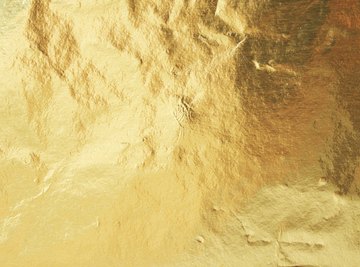
    • The gold foil experiment consisted of a series of tests in which a positively charged helium particle was shot at a very thin layer of gold foil. The expected result was that the positive particles would be moved just a few degrees from their path as they passed through the sea of positive charge proposed in the plum pudding model. The result, however, was that the positive particles were repelled off of the gold foil by nearly 180 degrees in a very small region of the atom, while most of the remaining particles were not deflected at all but rather passed right through the atom.

    Significance

    • The data generated from the gold foil experiment demonstrated that the plum pudding model of the atom was incorrect. The way in which the positive particles bounced off the thin foil indicated that the majority of the mass of an atom was concentrated in one small region. Because the majority of the positive particles continued on their original path unmoved, Rutherford correctly deducted that most of the remainder of the atom was empty space. Rutherford termed his discovery "the central charge," a region later named the nucleus.

    Potential

    • Rutherford's discovery of the nucleus and proposed atomic structure was later refined by physicist Niels Bohr in 1913. Bohr's model of the atom, also referred to as the Rutherford Bohr model, is the basic atomic model used today. Rutherford's description of the atom set the foundation for all future atomic models and the development of nuclear physics.

Related Searches:

Resources

  • Photo Credit Atom image by Sergey Tokarev from Fotolia.com

Comments

You May Also Like

  • Tin Foil Experiments

    Sometimes, science gets expensive, with the high prices of Bunsen burners, chemicals and specialized products. Cut the cost of science with a...

  • Ernest Rutherford Discoveries

    Numerous scientists have made significant contributions to the filed of physics throughout the centuries. Ernest Rutherford, an experimental physicist and Nobel Prize...

  • About Rutherford's Atomic Theory

    Rutherford's Atomic Theory was a revolutionary theory regarding the nature of atomic structure that varied significantly from past theories on the same...

  • Styrofoam and Aluminium Foil Experiments

    Styrofoam and Aluminium Foil Experiments. Experiments present an opportunity for students to demonstrate basic scientific principles in a manner that can be...

  • How to Add Silver Nitrate to Copper Foil

    Reacting silver nitrate with copper foil is a popular science experiment used to demonstrate single displacement reactions. In this case, silver in...

  • Who Discovered the Nucleus?

    Ernest Rutherford, considered the father of nuclear physics, was given this title for his discovery of the nucleus. Rutherford put forth the...

  • Atomic Structure of Gold

    In a physical science classroom, matter is anything that has mass and takes up space. All matter is made up of tiny...

  • Making Gold Leaf

    Crafter's make gold leaf by pounding out gold foil. Gold on fine, thin paper, called gold leaf, is an ancient art that...

  • Atomic Plum Pudding Theory

    Comments. You May Also Like. About Rutherford's Atomic Theory. In the early 1900s the predominant theory regarding how atoms were physically structured...

  • Uses of Gold Leaf Electroscopes

    Uses of Gold Leaf Electroscopes. The gold leaf electroscope has been used by physicists for hundreds of years. It indicates the presence...

  • The Best Origami Models for Foil Paper

    The Best Origami Models for Foil Paper. The art of origami--Japanese paper folding--consists of making intricate folds in special paper. Origami paper...

  • Gold Foil Effect in Photoshop

    People across the world desire the look of gold and gold foil, but many are unable to access it because of gold's...

  • How to Describe an Atomic Nucleus

    To describe an atomic nucleus, you need to grasp some of the basic concepts about the structure of life, and the way...

  • Atomic Theory Discoveries

    Atomic theory is the scientific theory that all matter is made up of extremely small discrete units of matter called atoms. Although...

  • How to Generalize the Results From an Experiment

    The goal of conducting an experiment is to prove a hypothesis, while the purpose of proving a hypothesis is to make a...

  • Basic Radioactivity Experiments

    You can perform many experiments to investigate radioactivity safely in the classroom or even at home. Radioactivity is natural and around us...

  • How to Apply Gold Leaf to Wood

    Applying gold leaf, or gilding, is a tradition that dates back to the Egyptians. It is a skill craftsmen have developed to...

  • Hydrogen Peroxide Experiments

    Hydrogen peroxide has a similar composition to water, but has an additional oxygen molecule. It has many uses around the home, including...

  • Gold Leaf Cards Craft Ideas

    Making your own cards for holidays or special events is a wonderful way to personalize a gift or express your thoughts. Add...

Related Ads

Featured