
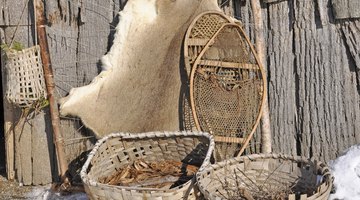


The people known as Iroquois called themselves Haudenosaunee, which means "the people of the longhouse." The word "Iroquois" is an aspersion cast by the Algonquin people and punctuated by the French -- it means "rattlesnakes." Although they obviously had enemies, the Haudenosaunee people were more politically complex, and perhaps more civilized, than the settlers with whom they fought and traded in the early days of the European colonization of North America.
The Six Nations
The Haudenosaunee are also known as the Six Nations because they are part of a confederacy of six tribes. Five of these tribes, the Mohawk, Cayuga, Oneida, Seneca and Onondaga, entered the confederacy before European settlement -- possibly as early as 1390, but more probably around 1570. A sixth tribe, the Tuscarora, joined in 1722. Their traditional lands are in upstate New York from the Adirondacks to Niagara Falls, but at the height of their conquests in 1680, they controlled an area that spread throughout the Ohio Valley to lower Michigan, southern Ontario and southwestern Quebec all the way through northern New England and south to Chesapeake Bay.
Home Life
The Iroquois subsisted primarily through agriculture, and the most important crops were corn, beans and squash. The men left the village in the fall to hunt, returning in midwinter and leaving again in the spring to fish. Iroquois society was matrilineal; when a man married, he moved into the wife's longhouse, and the children were part of her family. The longhouses, which could be hundreds of feet long, were covered with elm bark. The people were not nomadic, but they would relocate whenever the soil became too depleted to farm, which was about every 20 years or so.
The Haudenosaunee Confederacy
The Haudenosaunee political system included a two-house system similar to the British parliament and the United States Congress. Before the Tuscarora joined the confederacy, the Seneca and Mohawk tribes made up the first house while the Oneida and Cayuga tribes met in the other. The Onondaga had the ability to veto decisions made by these two houses. Each tribe sent representatives, called sachems, who were selected by the women of the tribes. An unwritten constitution governed the proceedings in the legislature, and although it predates the U.S. Constitution by hundreds of years, it included many of the same features.
Iroquois Mythology
Very little consistency exists in Iroquois mythology because the people ranged over such a wide area. Moreover, their traditions, carried on by the few survivors of disease and warfare, were greatly influenced by the adoption of Christianity. Most Iroquois myths include stories about Sky Woman, a mother goddess sometimes referred to as "Grandmother." Stories about Sky Woman often include her two sons, the Twin Gods, who personify the dualities of material existence. In common with many native North American tribes, the Iroquois also revere the Great Spirit, although there is no universally accepted meaning for this term.
Related Articles




References
Writer Bio
Chris Deziel has a bachelor's degree in physics and a master's degree in humanities. Besides having an abiding interest in popular science, Deziel has been active in the building and home design trades since 1975. As a landscape builder, he helped establish two gardening companies.