
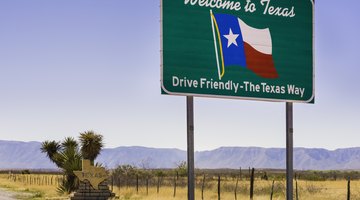


The origins of Texas can be confusing, especially to people who are new to studying American history. However, the origins of the name "Texas" are fairly clear. The name "Texas" comes from the Caddo word "Tejas," meaning "friends." The Caddo were some of the earliest residents of the land that would become Texas, and historians attribute the origin of the state's motto of "friendship" to the origin of this word that would give the state its name.
Tip
The name "Texas" originated from a word used by the indigenous people of the region that was said to mean "friends" or "allies."
History of Texas
Until the early 18th century, Texas was a large land mass that was part of the country of Mexico. New Mexico was already a part of the United States, and the term "tejas" or "teyshas" began to refer to the area of land north of the Rio Grande but east of New Mexico. Spanish missionaries came to the region in the 1500s when they began to interact with the native people who are believed to have inhabited the region for over 10,000 years.
The region was not particularly welcoming to foreigners, and the land's isolation from the rest of the United States meant that the area retained a very low population until after the American Revolution. Shortly thereafter, the war for Mexican independence was won, and the newly established Mexican government allowed settlers to live in the area north of the Rio Grande. As a result, the population in the area exploded, but almost none of these new citizens of the area had Mexican heritage. This created tension with the Mexican government.
The tension escalated to armed conflict after a number of minor skirmishes. This was followed by the beginning of the Texas Revolution, which was a battle between the newly settled European landholders and the Mexican government that technically had a right to the land and had granted Europeans the right to use the land. The Mexicans were defeated, and Texas won its independence.
Where Did the Name "Texas" Come From?
Even prior to the arrival of the Spanish missionaries in the 15th century, the word "tejas" was used commonly by the native population of the area. Roughly translated, it means "friends" or "allies." The word was derived from the word "teyshas," which was part of the language of the Caddo tribe. This word was commonly used to refer to people who were not part of the tribe but were not hostile to the tribe either.
When the Spanish missionaries arrived in the region in the 1540s, they heard the term "Teyshas." Rather than being the name of a particular group, the word was often used as a greeting the way one might say "hello, friend." However, the Europeans heard it applied to members of other groups or tribes and mistakenly assumed that it was the name of a neighboring tribe. They recorded it this way, and because of whom they assumed it referred to, the term became used as the name for the land area north of the Rio Grande.
Who Were the First Inhabitants of Texas?
When the Spanish missionaries first came to the region in the mid 1500s, they encountered many tribes of indigenous people. These people had populated the area for thousands of years. The region that would become Texas was then populated by an array of different tribes. Among them were the Caddo, the Tonkawa, the Tawakoni and Kitsau tribe and the Kiowa. These tribes mostly inhabited the regions to the northeast of Texas.
In the center of the region were the Comanches. The Comanche jurisdiction ran from top to bottom and across the center of what would later become the 28th state of the Union. On the southern border of the state's periphery were the Coahuilteco and Carrizzo tribes. Further west was the region belonging to the Jumanos and the tribes of the eastern Pueblos. The western border of the state was also partially populated by Apaches, most of whom lived even further west in what would become New Mexico.
The Apaches were much feared by many of the tribes in the region. Regarding the mistaken understanding of the use of the word "teyshas" or "tejas," one of the missionaries who lived among the Nabadaches attempted to correct the records. Francisco de Jesus Maria tried to explain that there was no "kingdom" of Texas and no "governor" and that the term "teyjas" was simply used to describe any of the tribes who had formed an alliance against the Apaches.
What European Nations Colonized Texas?
The French began the creation of a French colony in Texas in 1684. At that time, the Spanish and the French were enemies. Spain was looking to acquire as much land as it possibly could in the New World, and by colonizing any portion of the area near Mexico, the French represented a threat to their interests in the region.
However, the Karankawa tribe had sold canoes to the French, for which the French did not pay. Angry, the tribe exacted a violent revenge on the French settlers, massacring the population and sparing only the lives of four children. The destruction of the French colony and fort was a victory for Spain, who soon began to dispatch missionaries to the area. This was the beginning of Spanish control of the region that would secede and become Texas.
When Did the Spanish Build Missions in Texas?
In March of 1690, a Spanish expedition was launched with the endgame of establishing a Spanish mission in the region of east Texas. The mission was named San Francisco de los Tejas and had its inaugural mass on the first of June that year. The Spanish moved further east and continued to establish another mission in the area. Unfortunately, they were met with significant resistance from the native tribes who did not respect the priest and regularly robbed the colony of animals, food and other resources.
Frustrated with the problems in the area and with a decrease in the number of missionaries willing to risk their lives to convert the indigenous population, Spain began to move its interests out of Texas. The European colonists were further loathed for a smallpox epidemic that they seemingly brought to Texas and inflicted on the people native to the area. This infuriated the Caddo people, who threatened the lives of any Spanish remaining in the area. This began a 20-year period when Spain stayed out of Texas.
When Did Texas Gain Its Independence?
Texas became an independent nation in 1835. Still bordered by hostile opponents and somewhat adrift in North America, the Texas republic struggled to stay solvent and to protect itself from the invasion of nearby armies. Survival for citizens there was difficult during this time. A number of challenging factors arose that no one expected and made it difficult for the newly formed republic to survive independently.
In addition to the conflicts engendered by hostile local tribes, there was a language barrier with which to contend, and trade was difficult given that the area was landlocked and isolated. Building trade relationships with the colonies on the East Coast was difficult. After struggling for nearly 10 years to maintain a stable, independent republic, Texas approached the United States with the intention of joining the country.
The protection that the United States could offer to the fledgling region was valuable. Given the size and scope of the land on the Mexico border and the opportunities for farming, ranch work and other agricultural production, the land seemed promising. The alliance between the United States and its new 28th state looked to be reciprocally beneficial.
When Did Texas Officially Become Part of the United States?
Texas began to negotiate for inclusion in the United States. The country was attracted by the possibilities for farming that Texas offered, particularly farming cotton. The United States agreed to annex the nation, and Texas became the 28th state in the Union on December 29, 1845.
However, seceding from Mexican control and influence was not that simple. It took armed conflict, culminating in the Mexican-American War with the Treaty of Guadalupe Hidalgo, until Mexico officially recognized that Texas was an entity independent from Mexico belonging to the United States. Once the U.S. annexed Texas, the state began to grow along with the nation, but questions about its identity were far from over.
Many immigrants from the established U.S. states and Germany and other European nations had come to Texas, swelling the state's population and making it an increasingly vital asset. With most of its interests in farming, cotton and ranching, Texas's economy enormously benefited from the slave trade. Land was worked for free by slaves, and abolition threatened the state's prosperity.
Was Texas Part of the Confederacy?
In the middle of 1860, a rash of fires and small riots allegedly started by abolitionist slaves began to erupt in northern and eastern parts of Texas. The "Texas Troubles" saw the lynching of nearly 100 people, both black and white. The violence was used on both sides as an argument for the state to begin to secede from the Union. Thirty percent of Texas's population were owned slaves who accounted for a significant amount of unpaid labor.
In 1861, Texas seceded from the United States to join the Confederate States of America. Although Texas had a burgeoning population and many land interests, very few battles in the Civil War were actually fought in the state. Instead, Texas functioned largely as a place to supply the other states with weapons, soldiers and other sustenance while the fighting continued in the country's southeastern states.
In the middle of 1863, Union forces captured the area around the Mississippi River, which effectively trapped and stranded cattle, horses and other travel. Despite the economic dependence on slave labor in the region, only about 30 percent of white males of voting age actually supported the Confederacy. While large swaths of the population had Unionist views, the wealthy majority was on the side of the Confederacy, and Unionists – mostly immigrant families – were harassed and sometimes faced violence.
What Are Some Other Texas Facts?
San Antonio is the first and oldest city in Texas, but it is not the capital. The capital of Austin was founded and designated many years later when Texas officially became a state in the Union. Texas's war for independence culminated in the famous battle of the Alamo, wherein Mexican forces broke into the fort and killed all the settlers. Among those killed was noted frontiersman and Tennessee congressman Davy Crockett.
Texas gets its nickname "The Lone Star State" from the flag it adopted after securing its independence from Mexico. The area that would become Texas formerly had a flag with two stars between the red, white and green stripes that indicated the Mexican flag. After the fight to secede from Mexico and becoming its own independent nation, Texas created a flag with a single star. The single star or "lone star" symbolized bravery, determination, individualism and independence.
Related Articles






References
Writer Bio
Ashley Friedman is a freelance writer with experience writing about education for a variety of organizations and educational institutions as well as online media sites. She has written for Pearson Education, The University of Miami, The New York City Teaching Fellows, New Visions for Public Schools, and a number of independent secondary schools. She lives in Los Angeles.