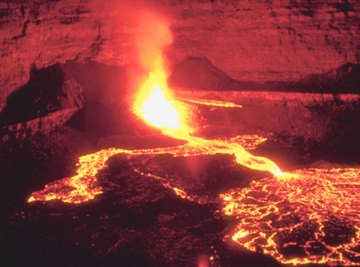
Volcanoes have captured the imaginations of science-fair participants for generations. The fun of simulating oozing lava and creating volcanic-like explosions is undeniable. Volcanoes play an important role in the topographical and meteorological patterns of Earth’s past, present and future. The complex science of volcanoes lends itself to a variety of science-project hypotheses.
Amateur Volcanologist
Volcanologists study both active and dormant volcanoes, how they formed, and their current and historic activity. According to the University of Oregon, most of the work of the volcanologist happens in the laboratory, not at the edge of a red-hot volcano writhing with molten lava. In fact, investigating data and coming up with hypotheses is one of the most important jobs of a volcanologist.
Hazardous Volcanoes
Volcanic eruptions have many hazards, from lava flows to spewing ash. Determining where the most hazardous volcanoes are located in the world is a good project hypothesis. First, students would need to determine the main hazards of a volcano and consider factors such as human life, plant and animal life, air quality and damage to property. Data would need to be collected on volcanoes in different parts of the world and students would need to form conclusions based on the same criteria for each volcano.
Effects on Earth System
Throughout history, volcanoes have had a profound effect on Earth’s systems. Volcanoes have changed the topography of the world and even destroyed civilizations. The effects on Earth’s systems by volcanoes that are currently active are more subtle, but they can still have an impact. Choosing an active volcano and hypothesizing about its impact on the environment around it would make an interesting project. Students can consider the impact to air quality, plant life and even the weather.
Chemistry and Volcanoes
A visually pleasing volcano project involves simulating an eruption. The intensity of volcanic eruptions varies widely and students can hypothesize which type of chemical reactions could cause the biggest eruptions. For example, a project could hypothesize that yeast combined with hydrogen peroxide would create a bigger explosion than vinegar combined with baking soda. Students, with adult supervision, can mix different components to demonstrate the power of volcanic eruptions.
References
About the Author
Beth Griesmer’s writing career started at a small weekly newspaper in Georgetown, Texas, in 1990. Her work has appeared in the “Austin-American Statesman,” “Inkwell” literary magazine and on numerous websites. Griesmer teaches middle school language arts and science in Austin, Texas.
Photo Credits
NA/AbleStock.com/Getty Images