
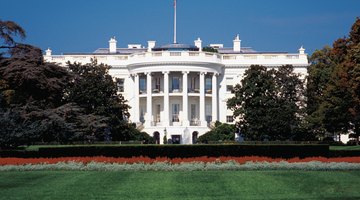


Ever wonder who "FICA" is and why they are taking money out of your paycheck? The "F" in FICA stands for the "federal" government. Governments are developed by people to ensure order in society and to protect citizens. Although governments exist in a variety of forms, they perform the same essential functions. The United States government is a federal system in which the federal and state governments share power and the Constitution outlines the responsibilities of the federal government.
Make Laws
The main function of the U.S. federal government is creating and enforcing laws to ensure order and stability within society. The U.S. Constitution outlines the nation's law-making process and establishes institutions to carry out this function. Our Founding Fathers feared the concentration of power in a single individual or branch of government. To prevent this, they separated law-making powers among three branches: legislative, executive and judicial. The legislature, composed of the House of Representatives and the Senate, creates laws. The executive branch enforces laws under the leadership of the president. The judiciary, which includes a federal court system headed by the Supreme Court, decides the constitutionality of these laws. This separation of powers prevents one branch from gaining influence over the others.
National Economy
The federal government also controls the nation's economy. Under the Articles of Confederation, states could print their own currency, which led to economic chaos. The Founding Fathers sought to combat these problems by creating a national currency and placing it under the control of the federal government. According to Article I, Section 8 of the U.S. Constitution, Congress has the authority to levy taxes, duties and excises to raise money in order to pay the country's debts. It can also borrow money and regulate both international and interstate commerce. Most importantly, Congress has the power to print or coin money, and to regulate its value.
National Security
Throughout history, war has been a main component of international relations. A major responsibility of any government is protecting its citizens. The Constitution places national defense in the hands of the federal government. It divides war powers between the president and Congress. Article I, Section 8 of the Constitution grants Congress the right to declare war and to maintain an army and navy. Article II, Section 2 names the president as commander-in-chief of the U.S. military and state militias, or national guards. Article I, Section 8 also authorizes Congress to grant the president the authority to place state militias under federal control to "suppress insurrections or repel invasions." By giving Congress the power to declare war and the president the power to wage war, the Founding Fathers ensured that one branch could not gain complete control over the nation's armed forces.
Foreign Policy
The federal government represents the nation's interests abroad. This duty is increasingly important as countries become more interconnected in the modern international system. The Constitution divides the authority for making foreign policy between the legislative and executive branches. The State Department maintains a network of embassies in countries around the world under the direction of the president. Diplomats send and receive messages to foreign heads of state on behalf of the president and negotiate treaties and trade agreements. According to Article II, Section 2, the Senate must consent to any treaty negotiated by the president and confirm any presidential nomination to a foreign post.
Related Articles








References
Writer Bio
Marci Sothern has written as a tutor in the academic field since 1999. She holds a bachelor's degree in history and a master's degree in political science from the University of Texas at Tyler. Her main areas of expertise include American history, comparative politics, international relations and political theory.