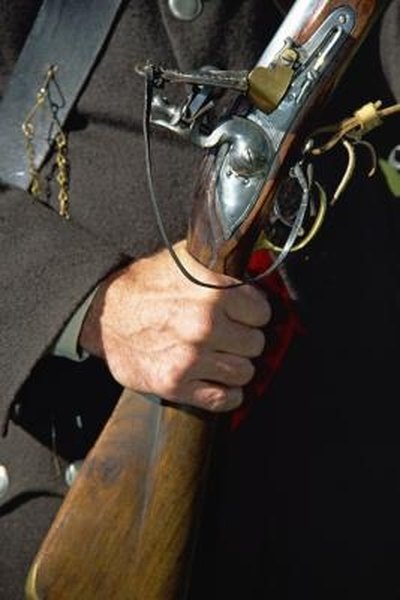



Muzzle-loading rifles were the most common rifle used by soldiers throughout the Civil War. The most common was the Springfield and the Enfield Rifle. The basic steps to load the rifle are the same. They shot a bullet, known as a minie ball and proved very effective through the Civil War. Firing these types of weapons must be done with great care, as the powder is extermely flammable and may be easily ignited by sparks.
Items you will need
Rifled musket
Percussion cap
Ramrod
Paper cartridge (contains minie ball)
Place the stock of the rifle on the ground. This will give it stability while you load it and allow the powder to fall down in the barrel.
Remove a paper cartridge from your satchel. Tear the paper open with your teeth and pour the powder in the paper down the barrel.
Place the minie ball, which came in your paper cartridge, into the barrel of your rifle. The minie ball will be snug, but not very tight.
Use the ramrod on the underside of your barrel to push the minie ball down into the barrel. The minie ball has a cone shape. Ensure the cone has the nose toward the end of the barrel. The bottom of the cone will be next to the powder, at the bottom of the barrel.
Ensure the ramrod is out of the barrel. Place it back into its holder below your barrel.
Place the percussion cap on the nipple of your gun. Check to make sure the percussion cap sits firm on the nipple. When the cap is struck, it provides the spark that ignites the powder in the barrel. The nipple of the gun is the place the hammer strikes when it falls.
Cock the hammer of your gun as far back as you can. The weapon is now ready to fire.
Pull the trigger. The hammer will fall. This will compress the percussion cap and cause a spark. The spark travels through a hole in the barrel and ignites the powder. The powder forces the minie ball to expand in the barrel and forces it out. The barrel has rifle grooves to give the minie ball more spin and more accuracy.
Warnings
- Know your target. Do not fire the rifle unless you have a clear, appropriate target. Ensure you load the minie ball in the correct direction and never double load minie balls in the rifle. Two minie balls in the rifle can cause the rifle to malfunction and injure you.
Tips
- These rifles are black powder rifles. Clean and maintain them on a regular basis to ensure they do not have lots of soot in the barrel, which can effect the performance of the weapon and shorten the longevity of the rifle.
References
Tips
- These rifles are black powder rifles. Clean and maintain them on a regular basis to ensure they do not have lots of soot in the barrel, which can effect the performance of the weapon and shorten the longevity of the rifle.
Warnings
- Know your target. Do not fire the rifle unless you have a clear, appropriate target. Ensure you load the minie ball in the correct direction and never double load minie balls in the rifle. Two minie balls in the rifle can cause the rifle to malfunction and injure you.
Writer Bio
Todd Young has been writing professionally since 2010, with travel-oriented pieces and other works appearing on various websites. He attended the University of Kentucky and earned a Bachelor of Arts in political science and a Bachelor of Arts in history.